

Laws and guidance checked October 2026
When you move out, the difference between “normal wear and tear” and “damage” decides how much of your deposit you get back. Landlords can charge for damage. They can’t charge for the normal effects of living in a home. This guide explains the difference with clear examples, shows how deposit disputes are actually decided in the US and UK, and gives you a step-by-step plan if money is taken unfairly.
Quick answer
Normal wear and tear is the gradual decline that comes from everyday living: faded paint, a few small nail holes, carpet worn flat in walkways, loose door handles. Damage comes from accidents, carelessness or misuse: large holes, burns, pet stains, broken blinds or a missing fridge shelf. Landlords can deduct for damage, unpaid rent and cleaning back to the move-in standard, but not for wear and tear, and not for a brand-new replacement of something that was already old.
The De Auditor’s Tip
The most valuable thing you own when you move out is a set of move-in photos. If you didn’t take any, start now: date-stamped photos of every wall, floor, appliance and fixture, saved somewhere other than your phone. It’s never too late to record the condition before you leave.
What “normal wear and tear” means
Normal wear and tear (called fair wear and tear in the UK) is the deterioration that happens through reasonable, everyday use, even when you look after the place. The UK’s Deposit Protection Service describes it as “deterioration in condition of the property due to reasonable use” (DPS). US states use similar wording. California, for example, says a landlord may not claim “for ordinary wear and tear or the effects thereof” (California Civil Code 1950.5).
Damage is different. It’s harm caused by misuse, neglect or an accident that goes beyond normal living. Ohio’s legal aid service puts it simply: damage is the result of misuse or preventable accidents (Ohio Legal Help).
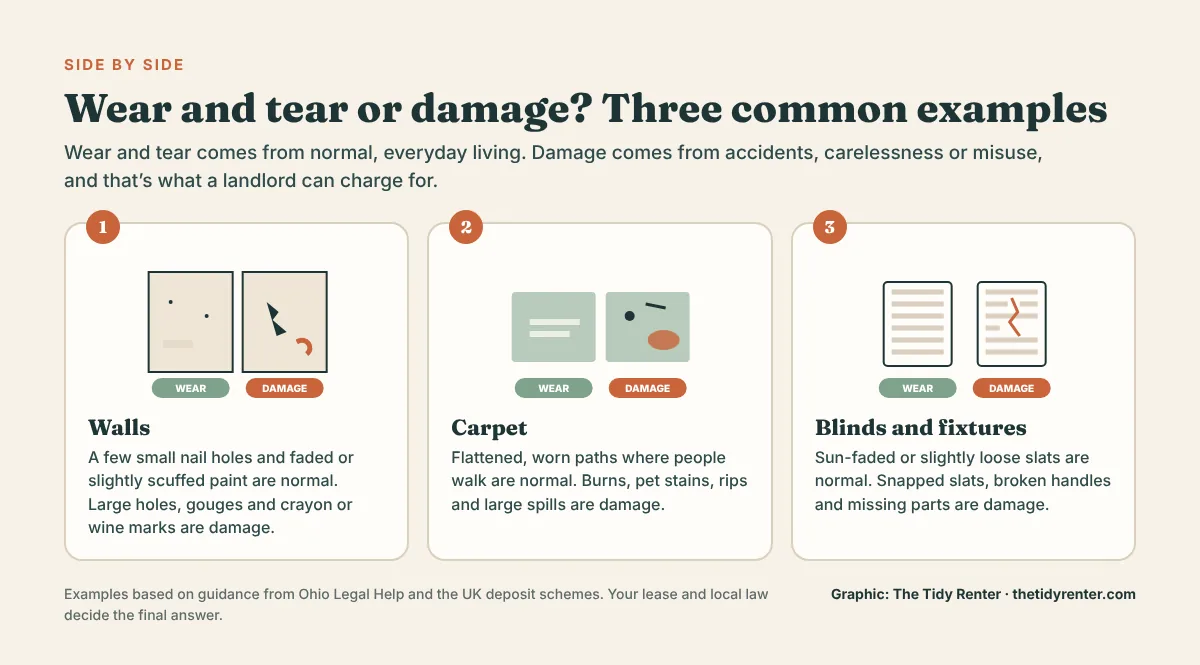
30+ examples: wear and tear or damage?
These examples follow guidance from legal aid services and the UK deposit schemes. The final answer always depends on the facts, the length of your tenancy and the condition at move-in.
| Area | Normal wear and tear (not chargeable) | Damage (can be charged) |
|---|---|---|
| Walls and paint | Faded or slightly scuffed paint; a few small nail or pin holes; light marks behind furniture | Large holes or gouges; crayon, ink or wine marks; unapproved paint colours; holes from heavy anchors |
| Carpet | Worn or flattened walkways; light dirt; slight fading from sunlight | Burns, rips, pet stains or odour; large permanent spills; bleach marks |
| Hard floors | Light surface scratches; dulled finish in busy areas | Deep gouges from dragging furniture; water damage from spills left to soak; burns |
| Kitchen | Worn countertop finish; loose cabinet hinges; an old appliance that stops working from age | Burns or knife cuts in counters; broken cupboard doors; a cracked hob; missing fridge shelves |
| Bathroom | Slightly worn grout or enamel; a dripping tap from old washers | Cracked sink or toilet; mould from never ventilating; a broken shower screen |
| Windows and blinds | Sun-faded blinds or curtains; slightly loose slats; sticking old windows | Broken or bent slats; torn curtains; a broken window or lock |
| Doors and fixtures | Worn door handles; loose hinges; light scuffs | Holes in doors; broken handles or locks; missing light fittings |
| Keys and locks | Re-keying between tenants | Re-keying because you lost keys or didn’t return them |
| Garden (UK) | Natural growth over a season | Dead plants you agreed to water; rubbish left behind; damaged fences |
Ohio Legal Help adds two useful rules: you shouldn’t be charged for damage that was there when you moved in, or for replacing something when a repair would do (Ohio Legal Help).
What landlords can deduct
- Unpaid rent and other charges your lease allows.
- Damage beyond normal wear and tear, at a reasonable cost.
- Cleaning, but only to the standard the home was in when you moved in. California’s law limits cleaning to returning the unit “to the same level of cleanliness it was in at the inception of the tenancy” (California Civil Code 1950.5). In the UK, deposit schemes flag clauses that demand professional cleaning regardless of the check-in condition as potentially unreasonable (DPS).
- Missing items that were listed in the inventory.
What they can’t deduct
- Normal wear and tear.
- Damage that was already there when you moved in.
- Upgrades, such as replacing old carpet with better carpet, or redecorating to a higher standard than at the start.
- The full cost of something that was already near the end of its life.
The lifespan rule: why you rarely pay for “new”
This is the part most renters don’t know. Even when something is genuinely damaged, a landlord usually can’t charge the full price of a new one. In the UK, adjudicators won’t award a claim that leaves the landlord better off than before, a principle called betterment. They split the cost based on how much life the item had left (Propertymark).
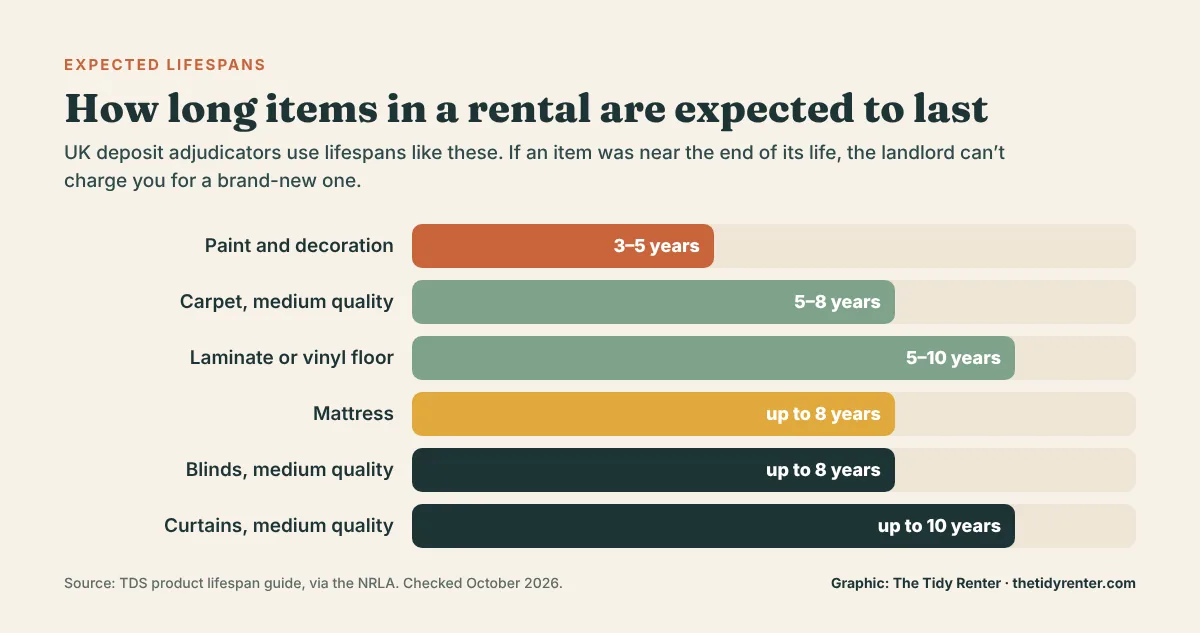
The TDS lifespan guide, published through the NRLA, gives typical figures: paint and decoration 3 to 5 years, medium-quality carpet 5 to 8 years, laminate or vinyl 5 to 10 years, and mattresses up to 8 years (NRLA).
A worked example. Propertymark uses a £500 carpet that was 2 years old with a 10-year expected life. It loses about £50 of value a year, so if it had to be replaced, the tenant’s share would be the remaining 8 years, £400, not £500. And if a stain could be cleaned for £50, the tenant pays £50, not the cost of a new carpet (Propertymark).
The same thinking applies to paint. If the walls were last painted four years ago and the guide says paint lasts 3 to 5 years, there’s little or no value left to charge you for, even if you left marks. The DPS notes that redecoration claims after five or more years are unlikely to succeed.

The De Auditor’s Note
Christian, founder of The Tidy Renter
Whenever a landlord quotes me the price of something “new”, my first question is always: how old was the one it replaced? Ask for the purchase date or receipt. Most landlords don’t have one to hand, and the lifespan rule often cuts a big claim down to a small one.
US rules: deadlines and your rights
Deposit law is set by each state, so check yours. A few things are common almost everywhere:
- A deadline to return the deposit. It ranges from 14 days in states such as New York to 60 days in a few others. California allows 21 days, and Washington and Massachusetts 30 (Nolo).
- An itemized list of anything kept. In California, receipts are required unless repairs and cleaning together come to $125 or less.
- A pre-move-out inspection. California landlords must offer one, no earlier than two weeks before you leave, so you can fix problems before they’re deducted.
- Photos. Since April 2025, California landlords must photograph the unit before and after repairs or cleaning they charge for. For tenancies starting on or after July 1, 2025, they must also photograph it at move-in (SF.gov).
- Penalties for bad faith. In California, keeping a deposit in bad faith can cost a landlord up to twice the deposit on top of what’s owed.
In Texas, the landlord doesn’t have to refund the deposit until you give a forwarding address, so always give one in writing.
UK rules: deposit protection and free disputes
- Your deposit must be protected. In England and Wales, landlords have 30 days to put it in a government-approved scheme and give you the “prescribed information”. If they don’t, a court can order them to pay you one to three times the deposit (Law Donut).
- There’s a cap. In England, a deposit can be no more than five weeks’ rent if the annual rent is under £50,000, or six weeks’ if it’s £50,000 or more (Oxford City Council).
- Return within 10 days of agreeing. Once you and the landlord agree the amount, it should be returned within 10 days. If you disagree, the money stays protected until the dispute is settled (Hinckley & Bosworth Borough Council).
- Free adjudication. Each scheme offers a dispute service where an independent adjudicator decides based on the evidence. You don’t need a lawyer.
Cleaning is the biggest battleground. In TDS’s 2024 figures, cleaning came up in 65% of disputes and damage to fixtures and fittings in 45%, with many disputes involving both (Property118, reporting TDS data).
How to protect your deposit before you leave
- Find your move-in evidence: the inventory or check-in report, photos and any emails about existing problems.
- Ask for a pre-move-out inspection if your state or landlord offers one. It tells you exactly what they’ll look at.
- Fix your own damage properly: fill small holes, re-hang doors, replace bulbs and put back anything you swapped out.
- Clean to the move-in standard: oven, fridge, bathroom limescale, inside cupboards and skirting boards are the usual problem areas.
- Record the condition when you leave: dated photos and a walk-through video of every room.
- Return every key and give your forwarding address in writing.
The De Auditor’s Tip
Patch small nail holes before you leave, but don’t paint over them unless you can match the exact paint and finish. A slightly different white or a shiny patch on a matt wall can look worse than the holes, and turn wear and tear into a repainting charge. Adhesive hooks need the same care: remove Command strips the right way so they don’t take paint with them.
How to challenge an unfair deduction
- Ask for the details in writing: an itemised list, receipts or quotes, and the photos the deduction is based on.
- Reply point by point. For each item, say whether it’s wear and tear, existing damage or a fair charge, and attach your evidence. Mention the item’s age and expected lifespan where it helps.
- Offer a fair amount if part of the claim is reasonable. Adjudicators and judges look kindly on people who are reasonable.
- UK: if you can’t agree, raise a dispute with the scheme protecting your deposit. It’s free.
- US: send a formal demand letter quoting your state’s deposit law and deadline. If that fails, small claims court is designed for disputes like this and usually doesn’t need a lawyer.

The De Auditor’s Note
Christian, founder of The Tidy Renter
Keep every message about your deposit in writing, even if your landlord prefers to call. A short email after a phone call saying “just to confirm what we agreed” turns a conversation into evidence. In a dispute, the person with the clearest paper trail usually wins.
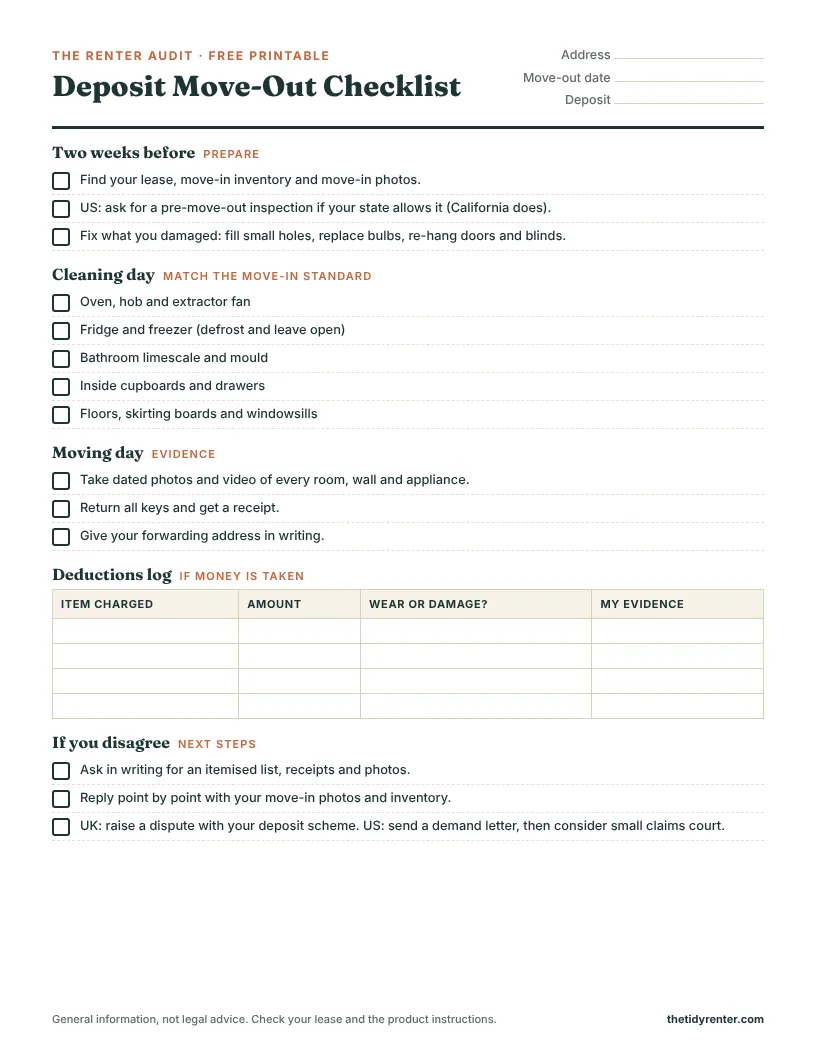
Free printable: Download the Deposit Move-Out Checklist (PDF). It covers what to do two weeks before you leave, a cleaning list, your moving-day evidence and a log for any deductions you want to challenge.

The De Auditor’s Note
Christian, founder of The Tidy Renter
I have rented for many years and moved home more than once for work. The lessons I share here have kept me out of trouble with landlords, and the habit I would put first is simple: photograph every room on the day you move in. Keep your proof and you keep your deposit.
Frequently asked questions
Are nail holes normal wear and tear?
A few small nail or pin holes from hanging pictures are generally treated as normal wear and tear. Lots of holes, large holes or holes from heavy wall anchors are more likely to count as damage. Check your lease, as some ban putting anything on the walls.
Can a landlord charge for repainting?
Not for normal fading and scuffs, which are wear and tear. They may charge for damage such as large marks or unapproved colours, but in the UK only a share based on how old the paintwork was. Paint is usually expected to last 3 to 5 years.
Can a landlord charge for carpet cleaning?
Only if the carpet is dirtier than when you moved in, beyond normal use. A blanket charge for professional cleaning, whatever the condition, may not be allowed. In the UK, deposit schemes see such clauses as potentially unfair.
How long does a landlord have to return my deposit?
In the US it depends on your state, usually between 14 and 60 days. In England and Wales, it should be returned within 10 days of you and the landlord agreeing the amount.
What if my deposit wasn’t protected in the UK?
If your landlord didn’t protect it within 30 days, you can apply to court. The court can order the landlord to repay the deposit and pay compensation of one to three times its value.
Who has to prove the damage?
In practice, the landlord needs evidence of the condition at the start and the end of the tenancy to justify a deduction. That’s why both sides’ photos and inventories matter so much.
The bottom line: landlords can charge for damage, unpaid rent and cleaning back to the move-in standard, but not for normal wear and tear or for brand-new replacements of old items. Good photos at both ends of your tenancy are the best protection you have.
Related guides on The Tidy Renter
- How to Hang Things Without Damaging Rental Walls: avoid the holes and marks that become deductions.
- Renter-Friendly Decor Ideas That Won’t Cost Your Deposit: decorate without risking your deposit.
- How to Declutter Your Home: A Room-by-Room Plan: get ready for move-out without leaving things behind.
Update log
- October 2026: First published. Laws and guidance checked.
Sources
- Ohio Legal Help: what is reasonable wear and tear?
- California Civil Code section 1950.5
- SF.gov: security deposit photograph requirements
- Nolo: state deadlines for returning security deposits
- Deposit Protection Service: in disputes, be fair
- Propertymark: what is fair wear and tear?
- NRLA: TDS product lifespan guide
- Law Donut: tenancy deposit protection key facts
- Oxford City Council: Tenant Fees Act 2019
- Hinckley & Bosworth Borough Council: tenancy deposit protection
- Property118: cleaning accounts for 65% of deposit disputes
Images: all graphics and the printable in this guide were designed by The Tidy Renter. No AI-generated images are used.
This guide is general information, not legal advice. Deposit law varies by state and country. For a specific dispute, contact a local legal aid service, Citizens Advice or Shelter.