
By Christian, the De Auditor · Updated October 2026 · Prices checked October 2026
You want your walls to look like home. Your landlord wants them to look exactly as they did on move-in day. This guide covers every way to hang art, mirrors, shelves and hooks in a rental, with how much each one holds, what it costs, and how to get it down again without taking the paint with it.
Quick answer
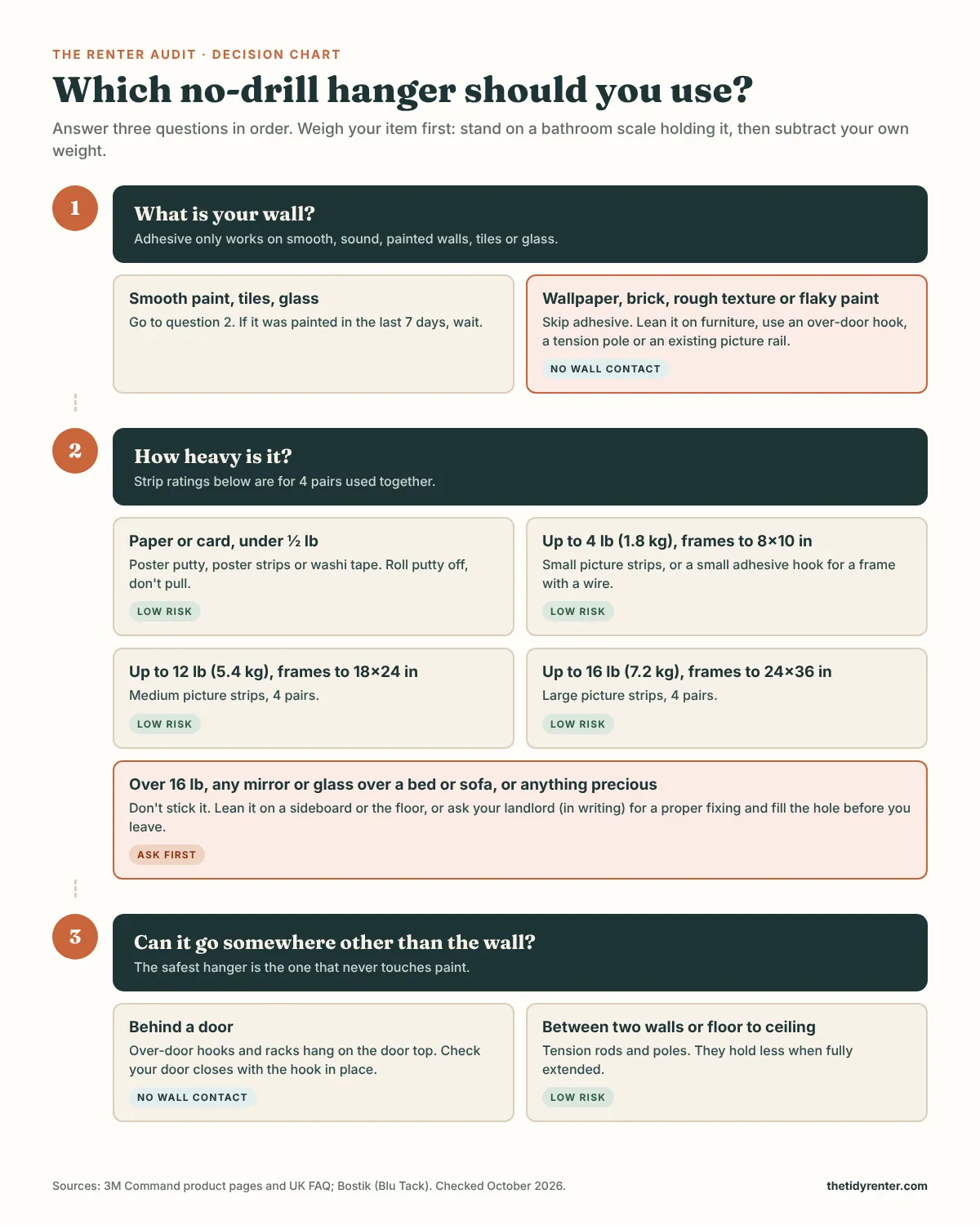
For framed art up to 16 lb (7.2 kg) on smooth painted walls, use picture-hanging strips: four pairs of large strips hold 16 lb, and they come off cleanly if you pull each tab slowly straight down. For anything heavier, any mirror over a bed, or walls with wallpaper or texture, don’t stick it: lean it on furniture, use a tension pole, or ask your landlord in writing for a proper fixing.
Best for most renters: picture strips for frames, over-door hooks for coats and bags, leaning for big mirrors.
At a glance: every method compared
| Method | Holds up to | Cost | Deposit risk | Best for | Effort |
|---|---|---|---|---|---|
| Picture-hanging strips | 16 lb (7.2 kg) with 4 large pairs | $ | Low | Framed art, light mirrors | 5 min |
| Adhesive hooks | 0.5 to 3 lb (0.2 to 1.3 kg) | $ | Low | Keys, small frames with wire, string lights | 2 min |
| Leaning on furniture or the floor | No limit (furniture permitting) | Free | None | Big mirrors, large art, heavy frames | 2 min |
| Over-door hooks and racks | Varies by rack | $ | None | Coats, bags, towels, wreaths | 1 min |
| Tension rods and poles | 5 to 44 lb (2.3 to 20 kg), depending on the rod | $ to $$ | Low | Alcoves, window recesses, between two walls | 10 min |
| Existing fixtures (picture rails, old nails, curtain poles) | Depends on the fixture | Free to $ | None to low | Older buildings, UK period flats | 5 min |
| Poster putty and washi tape | Paper and card only | $ | Low | Posters, prints, kids’ art | 1 min |
| Thin-pin hooks and Monkey Hooks | 20 lb (9 kg) and up | $ | Medium (small holes) | Heavier frames, with permission | 5 min |
| Freestanding displays (easels, ladders, room dividers) | Depends on the piece | $$ | None | Gallery walls without the wall | 10 min |
| Nails or screws with written permission | Depends on the fixing | $ | Medium to high | Heavy mirrors, shelves, TV mounts | 20 min + repair |
Cost bands: $ = under $15 / £12 · $$ = $15 to $60 / £12 to £50. Weight limits are the maker’s stated maximum.
Before you hang anything: the 5-minute deposit check
Do these four things first. They take five minutes and they are what wins deposit disputes.
- Read your lease for the words “nails”, “adhesive”, “alterations” or “decorating”. Some leases ban adhesive hooks and Blu Tack too, not just nails.
- Photograph every wall in daylight before you hang anything. Get close-ups of existing holes and marks. Keep the photos somewhere dated, like your email or cloud storage.
- Check the move-in report or inventory. If existing holes or nails aren’t listed, add them and send a copy to your landlord or agent.
- Weigh what you want to hang. Stand on a bathroom scale holding the item, then subtract your own weight. Most failures happen because people guess.
What the rules say, in short:
- US: Small nail holes from hanging pictures are generally treated as normal wear and tear, which landlords can’t charge for. Large holes, drilled holes, lots of holes in one area, or damaged paint can be charged, often around $5 to $25 per hole (iPropertyManagement). Rules vary by state and lease.
- UK: Minor scuffs and faded paint are fair wear and tear. Holes and deep gouges can be deducted. Your deposit must be held in one of three government-backed schemes (DPS, mydeposits or TDS), and each offers free dispute resolution backed by your check-in and check-out reports (Lemonade UK).
1. Picture-hanging strips
| Renter Audit | |
|---|---|
| Cost | Small pack from about $7; a 28-pair medium and large pack was $19.97 at Home Depot. UK: £16.99 for 4 large and 8 extra-large pairs at John Lewis |
| Deposit risk | Low, if your wall suits them and you remove them correctly |
| Space gained | Wall space for art and light mirrors |
| Effort | 5 minutes, plus a 1-hour wait |
Picture strips are two interlocking strips, one on the frame and one on the wall, that click together like hook-and-loop fastener. A stretch-release adhesive lets you pull them off later.
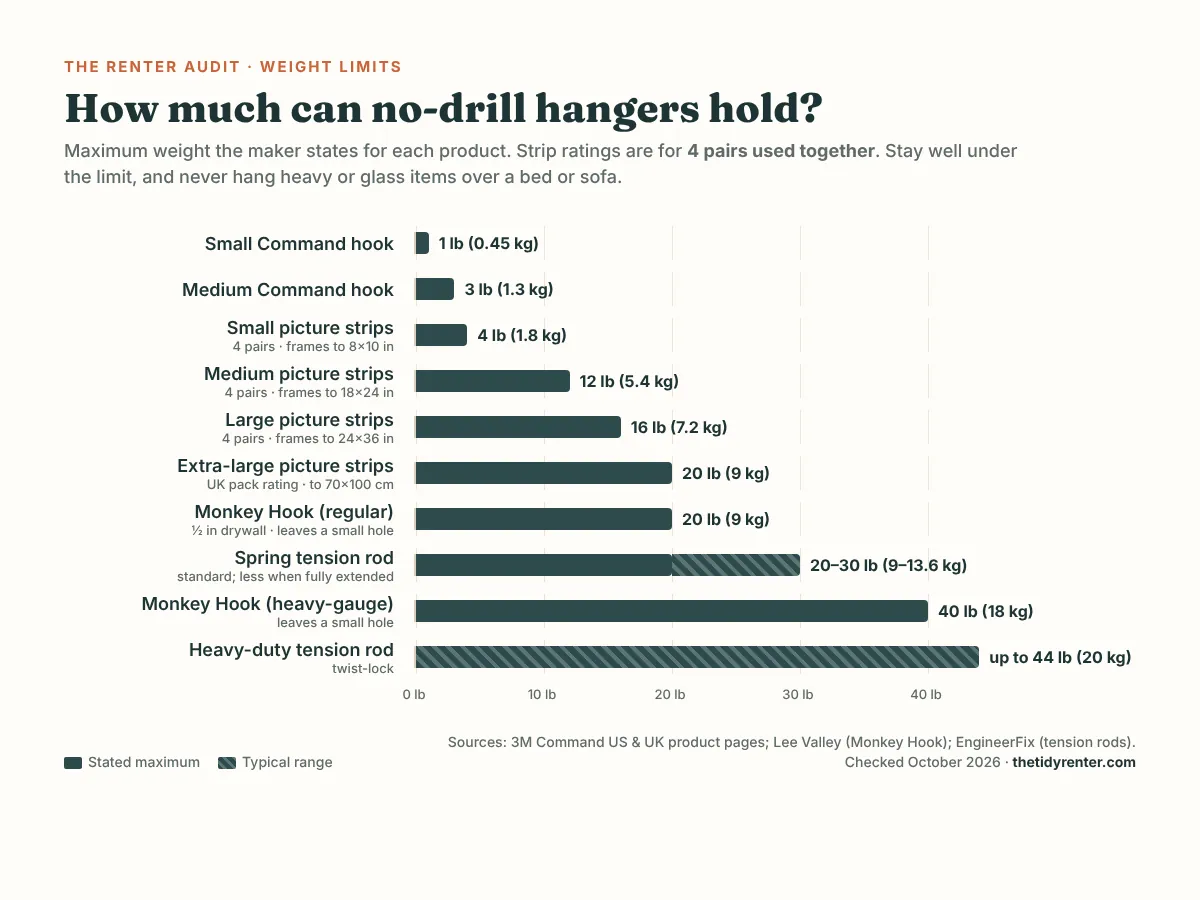
How much they hold (Command, the best-known brand):
| Size | One pair holds | Four pairs hold | Biggest frame |
|---|---|---|---|
| Small | 1 lb (0.45 kg) | 4 lb (1.8 kg) | 8 × 10 in (20 × 25 cm) |
| Medium | 3 lb (1.3 kg) | 12 lb (5.4 kg) | 18 × 24 in (46 × 61 cm) |
| Large | 4 lb (1.8 kg) | 16 lb (7.2 kg) | 24 × 36 in (61 × 91 cm) |
| Extra-large (UK packs) | — | up to 9 kg (20 lb) | 70 × 100 cm (28 × 39 in) |
Sources: 3M Command US product page and UK FAQ; John Lewis. Some retailer listings show different numbers for the same pack (15 lb vs 16 lb for large strips), so go by the packet in your hand.
How many pairs do you need? Divide the frame’s weight by what one pair holds, round up, then add one pair as a safety margin. A 9 lb (4 kg) frame with large strips: 9 ÷ 4 = 2.25, round up to 3, add one = 4 pairs.
How to put them up so they stay up:
- Wipe the wall with rubbing alcohol (isopropyl), not a household cleaner, which can leave a slippery film. Let it dry.
- Make sure the paint is at least 7 days old and the room is between 50°F and 105°F (10°C and 40°C).
- Press the strips together, peel the backing, and stick one side to the frame.
- Place the frame on the wall and press each pair firmly for 30 seconds.
- Pull the frame off the wall (bottom corners first), press the wall side again for 30 seconds, then wait one hour before hanging the frame back on.
Where they don’t work: wallpaper, brick, rough texture, flaky or chalky paint, and anything over a bed. 3M itself says not to use them on wallpaper or for valuable items (3M).
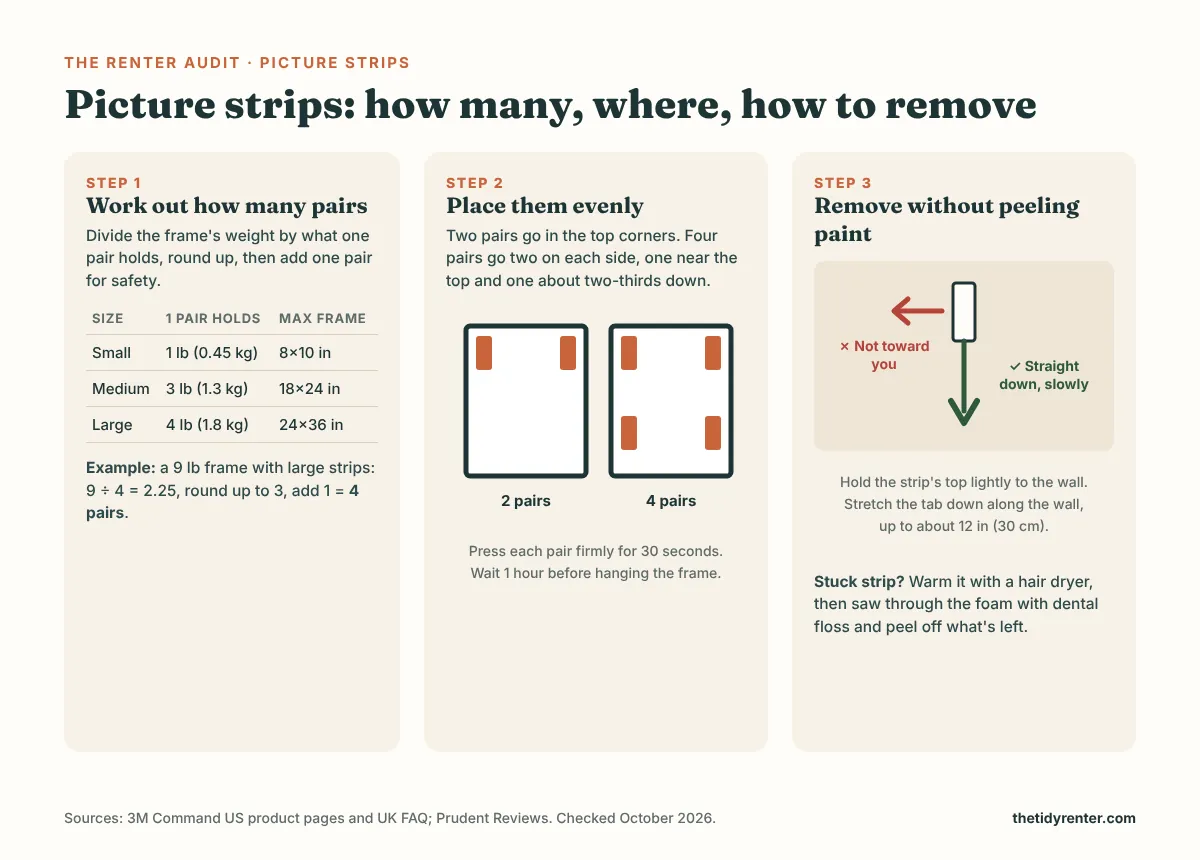
How to take them off: take the frame off by pulling the bottom corners away gently so the strips unclick. Then hold the top of the wall strip lightly, grab the tab, and stretch it slowly straight down along the wall, up to about 12 in (30 cm), until it lets go. Never pull it toward you. If a strip snaps or won’t release, warm it with a hair dryer, saw through the foam with dental floss, and peel off what’s left (3M UK).
What goes wrong: buyers’ most common complaints are frames falling and paint coming off with the strip. The usual causes are too few strips for the weight, skipping the 30-second press, hanging the frame too soon, textured or freshly painted walls, and pulling the tab outward instead of down (Prudent Reviews).
2. Adhesive hooks
| Renter Audit | |
|---|---|
| Cost | A pack of small wire hooks was $6.99 at Target |
| Deposit risk | Low |
| Space gained | Hanging space for keys, lights, small frames and utensils |
| Effort | 2 minutes, plus a 1-hour wait |
Adhesive hooks use the same stretch-release strips, with a hook on the front. They’re made for light things.
- Small wire hooks: about 0.5 lb (0.2 kg) each (Target listing). Good for string lights and tiny frames.
- Small hooks: about 1 lb (450 g). Medium hooks: about 3 lb (1.3 kg) (3M UK).
Don’t double up: two hooks don’t hold twice the weight. 3M says it doesn’t recommend using several hooks for one heavier item (3M UK). Use picture strips instead.
Where people use them most: inside cupboard doors, by the front door for keys, on bathroom tiles for towels (tiles are one of the best surfaces for adhesive), and on the side of a fridge for oven mitts.
3. Lean it instead
| Renter Audit | |
|---|---|
| Cost | Free, using furniture you already own |
| Deposit risk | None |
| Space gained | Display space on dressers, shelves, mantels and floors |
| Effort | 2 minutes |
The safest hole is the one you never make. Leaning is how designers show big art, and it’s the right answer for anything heavy.
- Big floor mirrors: stand them on the floor against the wall at a slight angle. Put a rubber furniture pad under the bottom edge so it can’t slide.
- Art on furniture: lean one large piece and one or two smaller ones in front of it on a dresser, console table or deep windowsill. Overlapping frames looks deliberate.
- Picture ledges: a ledge such as IKEA’s MOSSLANDA (55 cm long, holds 5 kg, £4 in the UK, IKEA) needs screws to mount, so it’s only no-drill if you stand it on top of a bookcase or sideboard. If you want it on the wall, ask your landlord first.
Safety: keep leaning mirrors out of walkways, and never lean anything heavy where children or pets can pull it over.
4. Over-door hooks and racks
| Renter Audit | |
|---|---|
| Cost | $ (single hooks to full racks) |
| Deposit risk | None (nothing touches the wall) |
| Space gained | Lots: the back of every door is unused storage |
| Effort | 1 minute |
Over-door hooks hook over the top of a door and hang down the back. They’re the easiest no-damage storage there is.
Measure first: check your door’s thickness. Most hooks fit standard interior doors of about 1⅜ in (35 mm). Thicker doors and fire doors (common in UK flats) may need an adjustable hook. Then close the door with the hook in place to check it shuts properly.
What goes wrong: metal hooks can scuff paint on the door top. Stick a strip of felt or clear protective film where the hook sits.
Use it for: coats, bags, towels, a full-length mirror (choose one designed to hang over a door), wreaths and shoe organizers.
5. Tension rods and tension poles
| Renter Audit | |
|---|---|
| Cost | A light-duty 28 to 48 in rod was $2.97 at Target; a sturdier rod was $9.99 at Ace Hardware |
| Deposit risk | Low (the end caps can mark soft paint) |
| Space gained | High in alcoves, window recesses, showers and under sinks |
| Effort | 10 minutes |
A tension rod is a spring-loaded bar that presses against two opposite surfaces. A tension pole does the same thing floor to ceiling, with shelves or hooks attached.
How much they hold:
- Light-duty rods: around 5 lb (2.3 kg). The Target rod above is rated at 5 lb (Target). Fine for a café curtain, not for a shelf.
- Standard spring rods: about 20 to 30 lb (9 to 13.6 kg).
- Heavy-duty twist-lock rods: up to about 44 lb (20 kg).
Capacity drops sharply as you extend a rod toward its maximum length, so buy one whose range puts your space in the middle (EngineerFix). For a 30 in (76 cm) alcove, a 28 to 48 in rod is a poor choice; a 24 to 36 in rod is better.
Clever renter uses: a second rod under the sink to hang spray bottles; a rod across a closet alcove for extra hanging space; two rods in a window recess with a board across as a plant shelf; a floor-to-ceiling pole with shelves in a bathroom corner.
Deposit tip: rubber end caps can leave rings on soft or matte paint. Put a small felt pad or a piece of clear film under each end.
6. Use what’s already there
| Renter Audit | |
|---|---|
| Cost | Free (S-hooks and picture-rail hooks are $) |
| Deposit risk | None to low |
| Space gained | Depends on what your home has |
| Effort | 5 minutes |
Look around before you buy anything.
- Picture rails (very common in older UK and Irish homes): the wooden moulding that runs round the room near the top of the wall was made for exactly this. Buy picture-rail hooks and hang frames on cord or chain. No holes at all.
- Nails and screws left by the last tenant: if they’re listed on your move-in report, you can use them. Write down which ones you used.
- Curtain poles and rails: S-hooks on a curtain pole can hold lightweight hanging planters or a lightweight fabric hanging.
- Cabinet doors and closet rails: S-hooks and hanging organizers turn these into storage.
7. Poster putty and washi tape
| Renter Audit | |
|---|---|
| Cost | $ |
| Deposit risk | Low (oily marks if left on porous walls for months) |
| Space gained | Wall space for paper prints |
| Effort | 1 minute |
Poster putty (Blu Tack, Loctite Fun-Tak and others) is for paper and card only, never frames.
The risk: Bostik, the maker of Blu Tack, says it can leave “a slight oily residue if left in place for months” on porous, absorbent or recently decorated surfaces (Bostik). Most painted walls are lower risk.
To remove it: roll it off the wall rather than pulling, then dab leftover bits with a fresh lump of putty. For a mark, patch-test a citrus cleaner or chewing-gum remover somewhere hidden, then dab (don’t rub) and blot dry.
Washi tape is a low-tack paper tape made for this kind of job. It’s the gentlest option for prints and kids’ drawings, but it won’t hold anything heavy and can lose grip in humid rooms.
8. Small-hole hangers (with permission)
| Renter Audit | |
|---|---|
| Cost | A 10-pack of Monkey Hooks was $5.97 at Home Depot |
| Deposit risk | Medium (small holes to fill before you leave) |
| Space gained | Wall space for heavier frames |
| Effort | 5 minutes, plus 10 minutes to fill holes at move-out |
These aren’t no-damage, but they’re the next best thing for heavy frames.
- Monkey Hooks are a curved steel wire you push and twist through drywall (plasterboard) by hand, no tools needed. Ratings vary by version and seller: Lee Valley lists 10 lb for the low-profile version, 20 lb for the regular one in ½ in drywall and 40 lb for heavy-gauge (Lee Valley), while Home Depot’s listing says 35 lb (Home Depot). We’d go by the lower figure. They only work in hollow drywall, not in solid plaster or brick.
- Thin-pin picture hooks use one or more very fine hardened pins. They leave a hole about the size of a pin.
Before you use them: check the lease, ask in writing, and plan to fill each hole with spackle (US) or Polyfilla (UK) before you move out.
9. Freestanding displays
| Renter Audit | |
|---|---|
| Cost | $$ |
| Deposit risk | None |
| Space gained | A “wall” anywhere you want one |
| Effort | 10 minutes |
If you want a gallery wall but your walls are off-limits, bring your own wall.
- Leaning ladder shelves give you shelves without fixings. Many come with a small anti-tip strap; see the safety note below.
- Easels show off one large piece, and they’re easy to move.
- Folding room dividers and pegboard panels on a stand can hold small frames, clips and baskets, and split a studio into zones at the same time.
10. Nails or screws, the right way
| Renter Audit | |
|---|---|
| Cost | $ for fixings and filler |
| Deposit risk | Medium to high without permission; low with permission and a proper repair |
| Space gained | Anything: heavy mirrors, shelves, TV mounts |
| Effort | 20 minutes, plus repair at move-out |
Sometimes the right fixing is a proper one. A 40 lb mirror needs a fixing into the wall, not a sticker.
- Ask in writing. Say exactly what you want to hang, where, and how you’ll repair it. Keep the reply.
- Use the smallest fixing that’s safe for the weight. Fewer, smaller holes are easier to fill.
- Repair before you leave: fill with lightweight spackle (US) or Polyfilla (UK), let it dry, sand it flush, and touch up only if you have the exact paint. Mismatched paint can look worse than a filled hole.
Safety: tall furniture needs anchoring
This one matters more than your deposit. The US Consumer Product Safety Commission recorded 234 deaths from clothing-storage furniture tipping over between January 2000 and April 2022, 199 of them children, and recommends anchoring dressers and similar furniture to the wall (CPSC). Since September 2023, new dressers sold in the US must meet a stability standard, but anchoring is still advised.
Adhesive strips are not strong enough to anchor furniture. If you have children or pets, ask your landlord for permission to fit an anti-tip strap with one small screw, and explain why. Most landlords will say yes, and a filled screw hole costs far less than an accident.
In the UK and Ireland
- Products: Command strips are sold at John Lewis and many other UK retailers, often in centimetre and kilogram sizes. Blu Tack and Polyfilla are the everyday names for putty and filler.
- Picture rails are common in Victorian and Edwardian homes. They’re the best no-damage option there is.
- Deposits: in England, Wales and Northern Ireland, your deposit must be protected in a government-approved scheme (DPS, mydeposits or TDS in England and Wales). Scotland has its own schemes. If you disagree with a deduction, use the scheme’s free dispute service.
- England: the Renters’ Rights Act 2025 made all new tenancies periodic from 1 May 2026 (Brodies). It doesn’t change the rules on decorating, so check your tenancy agreement.
- Walls: many UK flats have solid plaster or brick walls rather than drywall, so Monkey Hooks won’t work. Adhesive, leaning and picture rails are your friends.
What I’d skip
- Using several adhesive hooks for one heavy item. The maker advises against it.
- Anything stuck above a bed, sofa or cot. If it falls, it lands on someone.
- Bargain no-name “heavy-duty” adhesive hooks with no stated weight limit or removal instructions. If the maker won’t say what it holds or how it comes off, it isn’t worth the risk to your deposit.
- Double-sided foam tape and hot glue. Neither is designed to come off a painted wall.
- The cheapest light-duty tension rods for shelves. A 5 lb rod is for curtains only.
Moving out: the clean-wall routine
- Take everything down at least a few days before your final inspection, so you have time to fix marks.
- Remove strips by stretching the tab straight down. Roll putty off.
- Fill any holes, sand flush and wipe off dust.
- Photograph every wall from the same angles as your move-in photos.
- If there’s a deduction, ask for an itemised list with photos and compare it with your move-in report. In the UK, use your deposit scheme’s free dispute service.
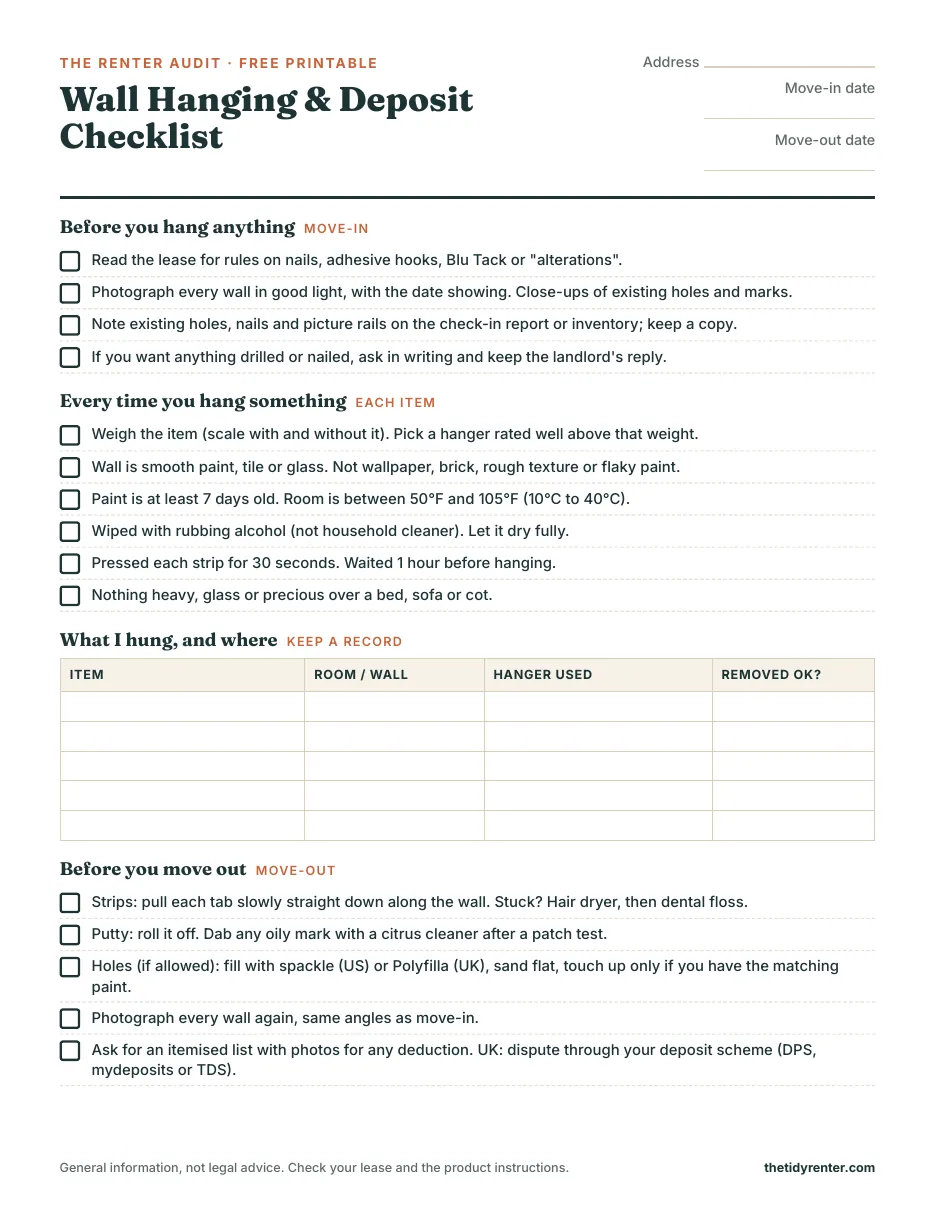
Free printable: Download the Wall Hanging & Deposit Checklist (PDF). It covers what to do at move-in, every time you hang something, and before you move out, with a table to record what you hung and where.
Related guides on The Tidy Renter
- Start here: How We Research: how every Renter Audit is put together.
- More in this topic: browse all Walls & Hanging guides.
- Free printable: Wall Hanging & Deposit Checklist (PDF).
Frequently asked questions
Will Command strips damage my walls?
They usually come off cleanly from smooth, fully cured paint if you stretch the tab slowly straight down along the wall. Damage tends to happen on fresh paint (under 7 days), on wallpaper or texture, or when the tab is pulled outward. 3M describes them as easy to remove but doesn’t guarantee no damage on every wall.
How long should I wait before hanging a picture on Command strips?
One hour after pressing the strips to the wall, according to 3M. Some magazines say 24 hours; waiting longer does no harm.
Can my landlord charge me for nail holes?
In the US, small nail holes from hanging pictures are generally considered normal wear and tear. Large holes, drilled holes or lots of holes can be charged, often around $5 to $25 per hole. In the UK, holes can be deducted from your deposit as damage, so ask first and fill them before you leave. Your lease and local law decide the details.
How do I hang a heavy mirror without drilling?
Lean it. Stand it on the floor or on a sturdy piece of furniture, at a slight angle, with a rubber pad under the bottom edge. Adhesive strips top out at around 16 to 20 lb and aren’t recommended for mirrors over beds or seating.
Does Blu Tack damage walls?
It can leave an oily mark on porous or freshly decorated walls if left up for months, according to its maker, Bostik. Roll it off rather than pulling, and use it only for paper and card.
What can I use instead of nails to hang pictures?
Picture-hanging strips, adhesive hooks, picture rails, over-door hooks, tension rods, leaning on furniture, easels and ladder shelves. The decision chart above shows which one fits your wall and weight.
Do Command strips work on textured walls?
Not well. They need a smooth, solid surface to grip. On textured walls, lean your art, use a picture rail if you have one, or ask permission for small-hole hangers.
How do I remove a Command strip that won’t come off?
Warm it with a hair dryer for about 30 seconds, then slide dental floss behind it and saw through the foam. Peel or stretch off what’s left. Don’t pry it with a knife.
The bottom line: match the hanger to your wall and the weight, press strips properly and give them an hour, and take them down slowly. For anything heavy, lean it or ask your landlord for permission. Your walls look like home, and your deposit comes back.
About the author
Christian, the De Auditor runs The Tidy Renter, where every renter idea is checked for cost, deposit risk, space gained and effort. He researches manufacturer specifications, landlord and tenant rules in the US and UK, and patterns in buyer reviews, so you don’t have to. How we research
Yes, It is me. I’m the De Auditor.
Update log
- October 2026: First published. Prices and weight limits checked.
Sources
- 3M Command: Large Picture Hanging Strips (US), Small Picture Hanging Strips (US), UK FAQ
- Home Depot: Command medium and large strips, 28 pairs
- John Lewis: Command large and extra-large strips
- Target: Command small wire hooks
- Target: Room Essentials 28 to 48 in tension rod
- Ace Hardware: Kenney 28 to 48 in tension rod
- EngineerFix: how much weight a tension rod holds
- Lee Valley: Monkey Hook
- Home Depot: Monkey Hook value pack
- IKEA UK: MOSSLANDA picture ledge
- Bostik: removing Blu Tack stains
- Prudent Reviews: picture-hanging strips
- iPropertyManagement: can a landlord charge for nail holes
- Lemonade UK: fair wear and tear
- Brodies: Renters’ Rights Act 2025
- CPSC: furniture tip-over standard
Images: all graphics, charts and the printable in this guide were designed by The Tidy Renter from the sources above. No AI-generated images are used.
This guide is general information, not legal advice. Check your lease and follow the manufacturer’s instructions.