

Prices and sizes checked November 2026
A small bedroom fills up fast: the bed takes most of the floor, the wardrobe is never big enough, and everything else ends up on a chair. In a rental you can’t add built-in cupboards or drill shelves wherever you like, so the storage has to come from the bed, the door, the walls you’re allowed to use and furniture you can take with you. This guide gives you 10 renter-safe ideas, the space each one needs, and a step-by-step plan to set up your bedroom in a weekend.
Quick answer
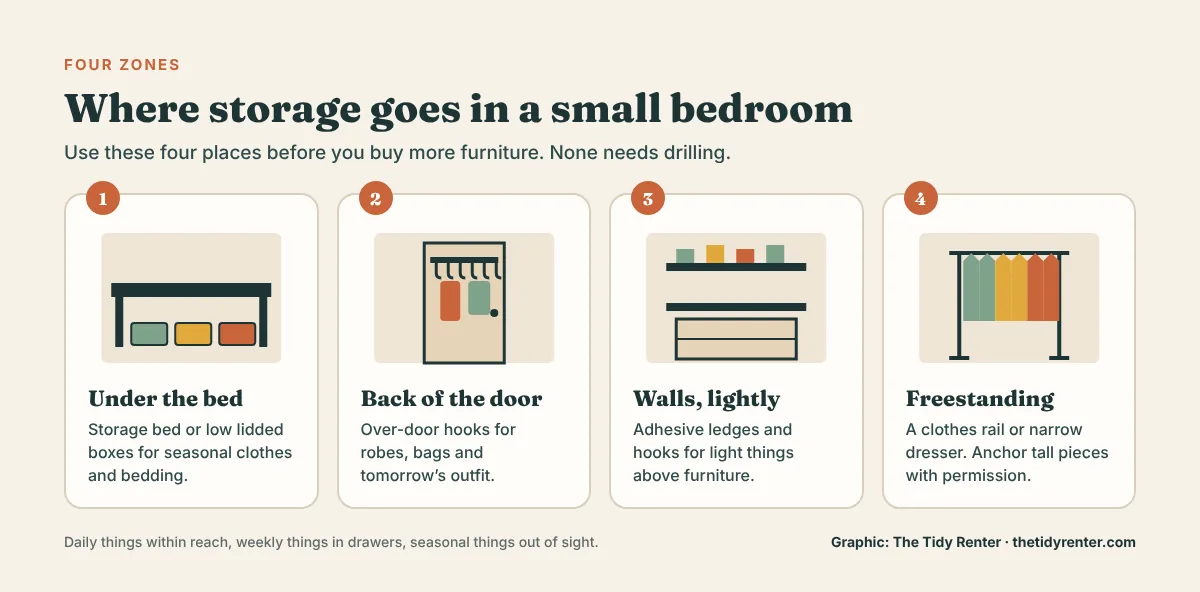
Start with the bed: a storage bed or low boxes underneath can hold a whole season of clothes. Then use the back of the door (over-door hooks hold about 8 lb or 3.6 kg), a freestanding clothes rail if the wardrobe is full, and a bedside table with a drawer instead of an open one. Keep at least 24 in (61 cm) clear on the sides of the bed you use, and anchor any tall dresser or wardrobe, with your landlord’s permission.
The De Auditor’s Tip
Before you buy anything, empty one drawer onto the bed and ask what each thing is doing in the bedroom. In most small rooms, a third of what’s stored there belongs in another room or in a donation bag.
How much space does a small bedroom need?
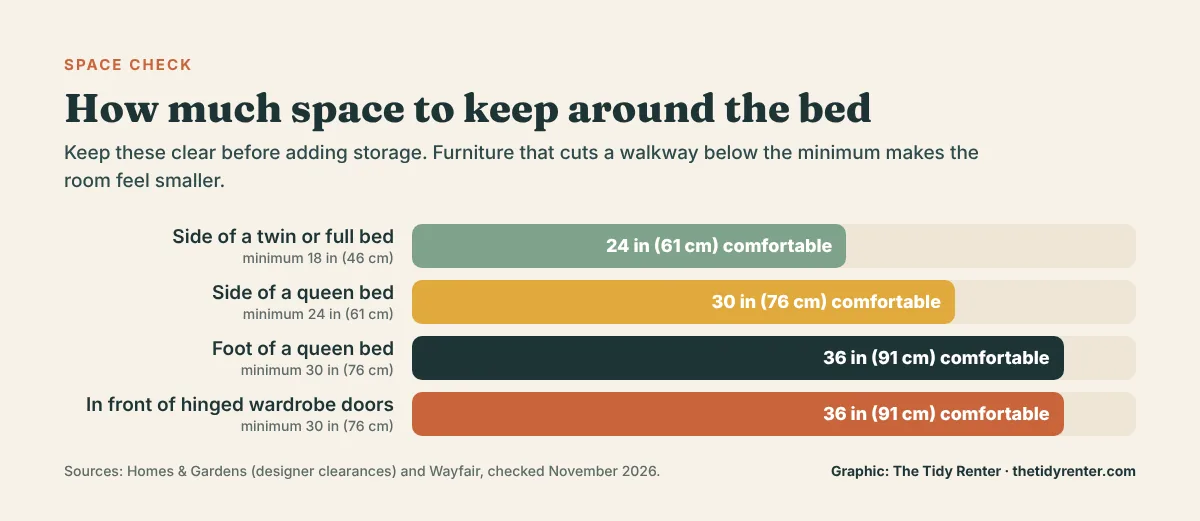
Small bedrooms are often around 8 x 10 ft (about 2.4 x 3 m), which suits a twin or full bed (Wayfair). The bed takes most of that floor, so the space you keep clear around it decides how much storage you can add.
| Space | Minimum | Comfortable |
|---|---|---|
| Each side of a twin or full bed | 18 in (46 cm) | 24 in (61 cm) |
| Each side of a queen bed | 24 in (61 cm) | 30 in (76 cm) |
| Foot of a queen bed to the wall | 30 in (76 cm) | 36 in (91 cm) |
| In front of hinged wardrobe doors | 30 in (76 cm) | 36 in (91 cm) |
Clearances from interior designers quoted by Homes & Gardens and Wayfair. If a piece of furniture would cut a walkway below the minimum, it will make the room feel smaller, however much it holds.
1. Choose a bed with storage built in
If you’re buying a bed anyway, a storage bed is the biggest single gain in a small bedroom. IKEA’s BRIMNES queen frame has four drawers, each about 37 x 21 x 8 in inside, for $334 in the US (IKEA US). In the UK the 150 x 200 cm version is £234, with four drawers of 95 x 54 x 20 cm (IKEA UK). That’s roughly a chest of drawers’ worth of space that takes up no extra floor.
| Renter Audit | |
|---|---|
| Cost | $334 / £234 (queen / UK king) |
| Deposit risk | None: freestanding |
| Space gained | About a dresser’s worth of drawers |
| Effort | Half a day to build |
Check the drawers can open fully: you need about 22 in (56 cm) clear beside the bed for them.
2. Use the space under the bed you already have
If your bed has legs, the gap underneath is often 7 to 12 in (18 to 30 cm) high. Low lidded boxes hold seasonal clothes and spare bedding, and rolling drawers work for shoes. Our under-bed storage guide shows how to measure the gap and which boxes fit.
| Renter Audit | |
|---|---|
| Cost | $10–$40 / £7–£30 |
| Deposit risk | None |
| Space gained | Seasonal clothes and bedding |
| Effort | 30 minutes |
3. Hang storage on the back of the door
An over-door hook rail is the fastest renter-safe win: no tools, no marks. Target’s Brightroom 6-hook rail costs $15, holds up to 8 lb (3.6 kg) in total and fits doors up to 1.58 in (4 cm) thick (Target). Use it for robes, bags and tomorrow’s outfit. A pocket organizer on the same door holds belts, scarves and small items.
| Renter Audit | |
|---|---|
| Cost | $10–$25 / £8–£20 |
| Deposit risk | Low: felt pads stop rubbing |
| Space gained | Hooks for 6 or more items |
| Effort | 2 minutes |
Close the door gently a few times after fitting. If the hook rail stops it shutting, stick a thin felt pad where the rail touches the frame.
4. Add a freestanding clothes rail
When the wardrobe is full, a clothes rail gives you hanging space without touching the walls. IKEA’s MULIG rail is about 39 in wide, 18 in deep and 60 in tall (99 x 46 x 152 cm) (Dimensions.com). Put it where a chair would go and keep it tidy: matching hangers and one colour group per rail make it look intentional rather than messy.
| Renter Audit | |
|---|---|
| Cost | $20–$60 / £15–£50 |
| Deposit risk | None |
| Space gained | Extra hanging space |
| Effort | 20 minutes |

The De Auditor’s Note
Christian, founder of The Tidy Renter
I’ve decorated every small room I’ve rented, and my rule for a clothes rail is simple: only this season’s clothes on it, on matching hangers. Kept like that, it looks like a feature. Overload it, and the whole room starts to look like a laundry heap.
5. Swap an open nightstand for one with a drawer
A small bedside table with a drawer and a shelf hides chargers, books and medicines, so the top stays clear. If there’s no room for a table at all, a bedside caddy that tucks under the mattress, or a clamp-on bedside shelf, holds a phone, glasses and a book in a few inches of space.
| Renter Audit | |
|---|---|
| Cost | $15–$80 / £12–£60 |
| Deposit risk | None |
| Space gained | A clear bedside |
| Effort | 10 minutes |
6. Put a storage bench or trunk at the foot of the bed
If you have at least 30 in (76 cm) between the foot of the bed and the wall, a low storage bench gives you a seat for putting on shoes and a box for spare blankets. Measure first: a bench 16 in (40 cm) deep in front of a queen bed still needs the walkway behind it.
| Renter Audit | |
|---|---|
| Cost | $50–$150 / £40–£120 |
| Deposit risk | None |
| Space gained | Blankets and a seat |
| Effort | 30 minutes |
7. Go up the walls with no-drill shelves
Use the wall above a desk or dresser for light things: adhesive picture ledges, Command hooks for bags and hats, or a leaning ladder shelf. Command Large hooks hold 5 lb each (3M); keep heavy items on furniture, not on adhesive. Our no-drill shelves guide compares the weight limits of each type, and our Command strip removal guide shows how to take them down cleanly.
| Renter Audit | |
|---|---|
| Cost | $10–$40 / £8–£30 |
| Deposit risk | Low if removed the right way |
| Space gained | Light items off the floor |
| Effort | 15 minutes |
8. Pick a tall, narrow dresser, and anchor it
A tall, narrow chest gives more drawers per square foot than a wide one. But tall clothing storage can tip over: the US Consumer Product Safety Commission counts 234 deaths from clothing storage tip-overs since 2000 and recommends anchoring dressers and wardrobes to the wall (CPSC). In a rental, ask your landlord first. Most agree to two small screw holes for safety, and you can fill them when you move out. If they say no, choose a low, wide dresser instead and keep it away from small children.
| Renter Audit | |
|---|---|
| Cost | $100–$300 / £80–£250 |
| Deposit risk | Low: two small holes with permission |
| Space gained | Most drawer space per square foot |
| Effort | 1–2 hours |
The De Auditor’s Tip
Put the heaviest things in the bottom drawers and never open more than one drawer at a time on a tall chest. It makes any dresser more stable, anchored or not.
9. Use the wardrobe from floor to ceiling
Most rental wardrobes waste the top shelf and the floor. Add a shelf divider or two lidded boxes on top for out-of-season things, and a low shoe rack or boxes on the floor. A second hanging rod that hooks over the first doubles the space for shirts and skirts. Our small closet organization guide shows the measurements.
| Renter Audit | |
|---|---|
| Cost | $15–$50 / £10–£40 |
| Deposit risk | None |
| Space gained | Up to twice the hanging space |
| Effort | 30 minutes |
10. Use vacuum bags for bulky bedding
Spare duvets and winter blankets take more space than anything else. Vacuum bags shrink synthetic bedding a lot, but don’t compress down, feathers or wool: use breathable bags for those. Store them under the bed or on the wardrobe shelf.
| Renter Audit | |
|---|---|
| Cost | $15–$30 / £10–£25 |
| Deposit risk | None |
| Space gained | Bulky bedding shrinks a lot |
| Effort | 15 minutes |
Step by step: set up your small bedroom storage in a weekend
- Measure the room. Note the floor size, the bed size, the door swing and the space beside and at the foot of the bed. Use the clearance table above.
- Sort before you store. Take everything out of drawers and the wardrobe. Keep only what belongs in a bedroom; move the rest or donate it. Our decluttering plan helps.
- Decide what goes where. Daily things go at arm’s reach (bedside drawer, door hooks), weekly things in the dresser and wardrobe, and seasonal things under the bed or on the top shelf.
- Start with the bed and the door. These two give the most space with no tools: boxes or a storage bed, and an over-door rail.
- Add furniture only where the walkway allows. Mark each piece’s footprint on the floor with painter’s tape before you buy it.
- Use the walls lightly. Adhesive hooks and ledges for light things only. Read the weight limits.
- Ask about anchoring. If you add a tall dresser or wardrobe, email your landlord for permission to anchor it and keep the reply.
- Protect your deposit. Felt pads under furniture feet, no adhesive on fresh paint, and photos of the walls before and after.
In the UK and Ireland
UK bedrooms are often smaller, and many have a divan bed with no space underneath. If yours has a divan, look for one with drawers, or use the wardrobe top and over-door storage. In a small UK single room, a slim clothes rail and a bed with drawers are often the best combination. The same anchoring rule applies: ask your landlord or agent in writing before fixing furniture to the wall.
What I’d skip
- Furniture that blocks the walkway. If you have to squeeze past it, it will make the room feel cramped.
- Heavy shelves on adhesive. Adhesive is for light things only.
- A tall dresser you can’t anchor. Pick a low one instead.
- Buying storage before sorting. You’ll buy boxes for things you don’t need.

The De Auditor’s Note
Christian, founder of The Tidy Renter
From a bedsitter to a room and parlour to a flat, I’ve learned that a small room works when every item has its place: daily things within reach, seasonal things out of sight. Sort first, then buy storage. The other way round, you just buy more boxes.
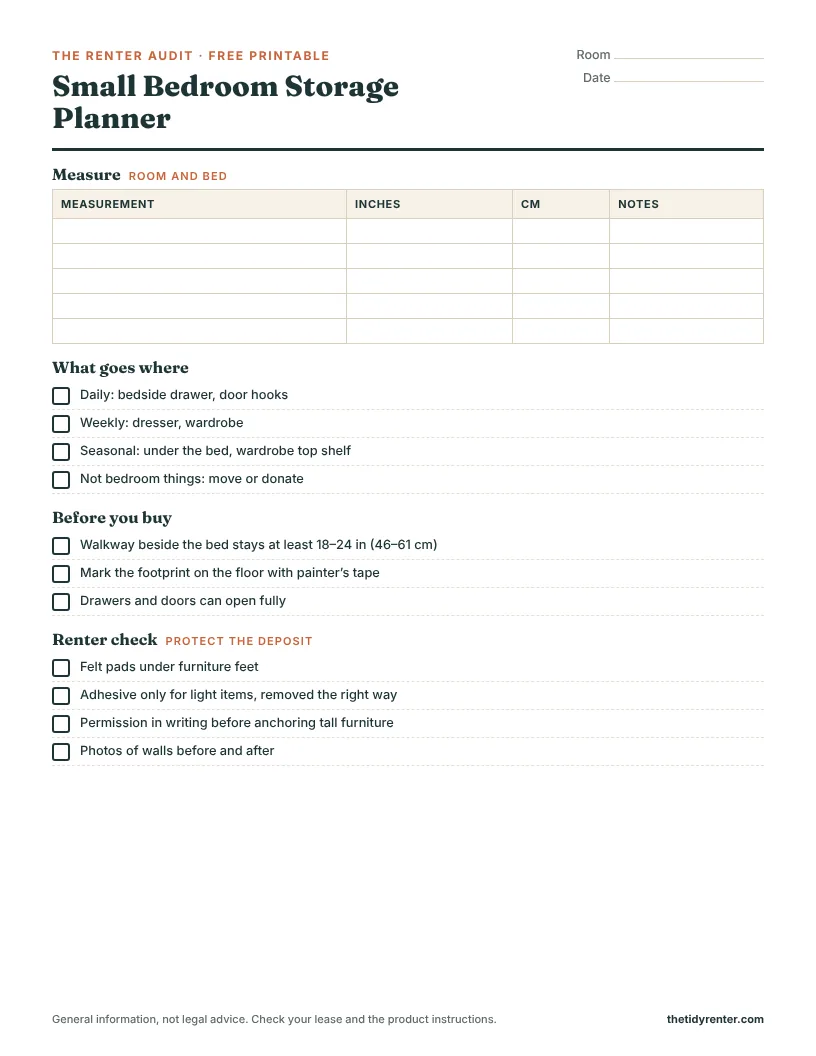
Free printable: Download the Small Bedroom Storage Planner (PDF). Measure your room, plan what goes where and tick off the renter checks.
Frequently asked questions
How can I add storage to a small bedroom without drilling?
Use the bed (a storage bed or boxes underneath), the back of the door (over-door hooks and organizers), freestanding furniture like a clothes rail or narrow dresser, and adhesive hooks for light items.
How much space do I need around the bed?
At least 18 in (46 cm) on the sides you use for a twin or full bed and 24 in (61 cm) for a queen, with 30 to 36 in (76 to 91 cm) at the foot if there’s furniture or a door there.
Do I need to anchor a dresser in a rental?
Safety experts recommend anchoring tall dressers and wardrobes, especially with children in the home. Ask your landlord in writing; most allow two small holes, which you fill when you leave.
Where should I store clothes if I have no wardrobe?
A freestanding clothes rail for hanging items, a dresser or drawer unit for folded clothes, and under-bed boxes for out-of-season things.
Is a storage bed worth it in a small room?
Usually yes. A bed with four drawers can replace a chest of drawers, freeing floor space. Check you have room beside the bed for the drawers to open.
The bottom line: start with the bed and the back of the door, add only the furniture your walkways allow, keep adhesive for light things, and anchor anything tall with your landlord’s permission. Sort first, then store.
Related guides on The Tidy Renter
- Under-Bed Storage Ideas That Actually Fit: measure the gap and choose the right boxes.
- Small Closet Organization Ideas That Actually Fit: double the hanging space without drilling.
- Small Apartment Storage Ideas for Renters: no-drill storage for every room.
Update log
- November 2026: First published. Sizes and prices checked.
Sources
- Homes & Gardens: expert guide to bedroom clearances
- Wayfair: what is the standard bedroom size
- IKEA US: BRIMNES bed frame with storage
- IKEA UK: BRIMNES bed frame with storage
- Target: Brightroom over-the-door 6-hook rail
- Dimensions.com: IKEA MULIG clothes rack
- 3M: Command Large Utility Hook
- US CPSC: clothing storage tip-over standard
Images: all graphics and the printable in this guide were designed by The Tidy Renter. No AI-generated images are used.
Prices are typical ranges and change often. Follow the manufacturer’s instructions for weight limits and anchoring.