

Prices and sizes checked November 2026
The space under your bed is the biggest piece of empty storage in most small rentals, and it’s also where most storage boxes go wrong. They are a centimetre too tall, catch on the centre rail, or end up so far under the bed that you never open them again. This guide shows you how to measure the gap properly, which boxes, drawers and bags actually fit, and how to raise the bed safely if you need more room.
Quick answer
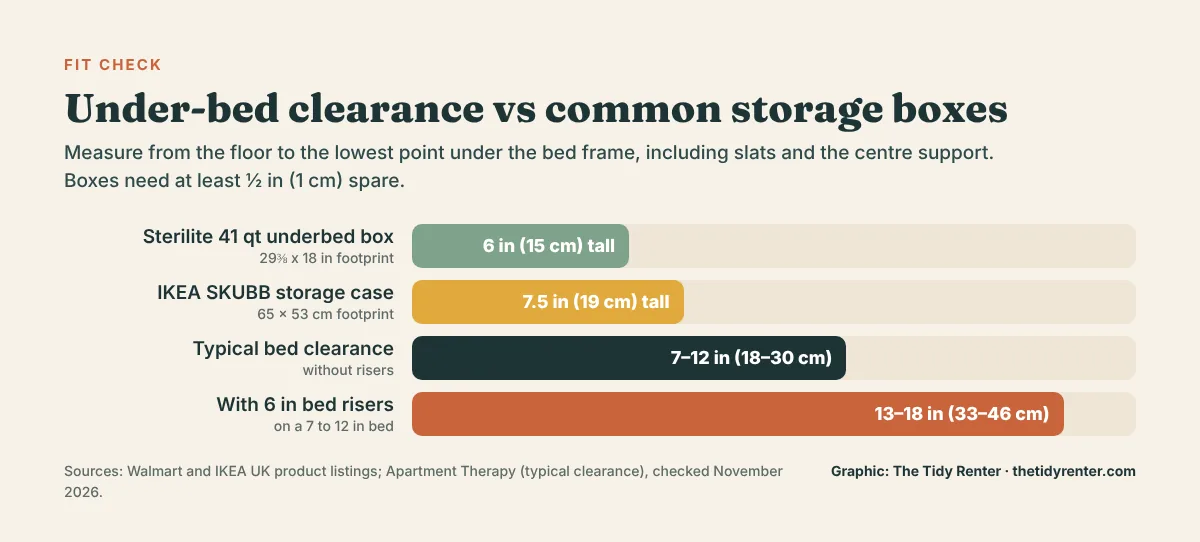
Measure from the floor to the lowest point under the bed, including slats and the centre support. Typical clearance is about 7 to 12 in (18 to 30 cm). Buy boxes at least ½ in (1 cm) lower than that: a 6 in (15 cm) lidded box fits most beds. Use rolling drawers at the front for things you use weekly and lidded boxes at the back for seasonal clothes. If the gap is too low, 6 in bed risers add room.
The De Auditor’s Tip
Measure in three places: the head end, the middle and the foot. Many bed frames have a centre rail or support legs that are lower than the sides, and that one measurement is the one that decides which box fits.
Step 1: Measure the space under your bed
- Clearance: measure from the floor to the lowest point of the frame, including slats, the centre rail and any support legs. Apartment Therapy puts typical clearance at about 7 to 12 in (Apartment Therapy).
- Width: measure the gap between the legs on the side you will pull boxes out from.
- Length: measure the bed’s length to see how many boxes fit side by side.
- Floor: note whether it’s carpet, wood or laminate. Boxes slide on hard floors but drag on carpet.
Leave at least ½ in (1 cm) above the box so it slides in without scraping the frame. Our small apartment storage guide includes a quick fit diagram if you want to see it drawn out.
Step 2: Choose the right type of storage
Choose by how often you need what’s inside. Things you use every week need to be at the front and easy to pull out. Seasonal things can go at the back.
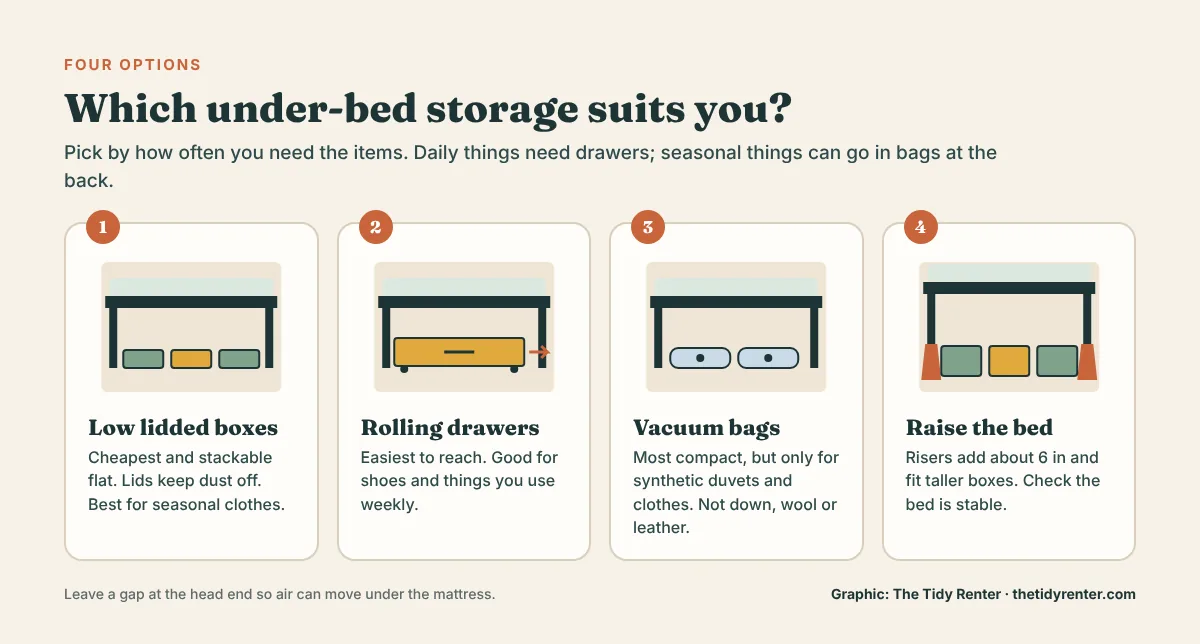
1. Low lidded plastic boxes
| Renter Audit | |
|---|---|
| Cost | About $10 / £7 to £15 each |
| Deposit risk | None |
| Space gain | High. Holds a season of clothes per box |
| Effort | Minutes |
Clear lidded boxes are the cheapest and most useful option. You can see what’s inside, and the lid keeps dust off. A Sterilite 41 qt underbed box measures 29⅜ x 18 x 6 in (75 x 46 x 15 cm) and costs about $10 at Walmart (Walmart listing), so it fits under almost any bed with 7 in or more of clearance. Label the long side that faces out.
2. Fabric storage cases with zips
| Renter Audit | |
|---|---|
| Cost | About £7 / $10 to $20 each |
| Deposit risk | None |
| Space gain | Medium to high |
| Effort | Minutes |
Soft fabric cases are lighter than plastic and fold flat when empty. IKEA’s SKUBB case measures 65 x 53 x 19 cm (about 25½ x 21 x 7½ in) and costs £7 in the UK (IKEA UK). At 7½ in tall, it needs a bed with at least 8 in of clearance. Fabric breathes better than plastic, which is good for wool and natural fibres, but it lets in more dust, so vacuum around it regularly.
3. Rolling drawers
| Renter Audit | |
|---|---|
| Cost | $25 to $60 / £20 to £45 each |
| Deposit risk | Low. Check the wheels on wooden floors |
| Space gain | Medium. Less capacity, much easier access |
| Effort | Minutes |
Under-bed drawers on wheels pull out like a real drawer, so they are the best choice for shoes, gym kit or anything you use every week. Wheels add height, so measure carefully, and choose soft rubber wheels on wooden or laminate floors. Apartment Therapy suggests adding low-profile caster wheels to an existing box if you already have one that fits (Apartment Therapy).

The De Auditor’s Note
Christian, founder of The Tidy Renter
The mistake I see most often is buying one giant box that takes two people to pull out. Under a bed, two or three smaller boxes are far more useful than one big one, because you can reach the one you need without moving everything else.
4. Vacuum storage bags (synthetic items only)
| Renter Audit | |
|---|---|
| Cost | $15 to $30 / £10 to £25 for a set |
| Deposit risk | None |
| Space gain | Very high for bulky bedding |
| Effort | 10 minutes |
Vacuum bags shrink spare duvets, pillows and winter coats to a fraction of their size, so they fit under even a low bed. But not everything should be compressed. Professional organisers quoted by Ideal Home say synthetic duvets are fine, while down, feather, wool, leather and silk should not be vacuum-packed because compression can damage them (Ideal Home). Everything must be completely clean and dry before it goes in, or it can go mouldy.
5. Raise the bed with risers
| Renter Audit | |
|---|---|
| Cost | $10 to $25 / £10 to £20 for a set of 4 |
| Deposit risk | Low with felt pads under each riser |
| Space gain | High. Adds about 6 in of height |
| Effort | 15 minutes, with a helper |
If the gap is too low, bed risers lift the whole bed. A common set of four adds 6 in (15 cm); Apartment Therapy lists one set that adds 6 in and supports up to 300 lb (Apartment Therapy). On a bed with 7 to 12 in of clearance, that gives you 13 to 18 in, enough for taller boxes or two layers of low ones.
Risers are only safe if the bed sits squarely in all four cups on a level floor. Don’t use them on beds with wheels or casters, check the weight rating covers the bed, mattress and people, and put felt pads under the risers to protect a wooden floor.
The De Auditor’s Tip
Do the riser lift with two people, one at each end, and lift one end at a time. Lifting a loaded bed alone is how frames crack at the joints, and a cracked frame in a furnished rental is something you’d have to pay for.
6. A bed with built-in storage
| Renter Audit | |
|---|---|
| Cost | $250 to $800+ / £200 to £600+ |
| Deposit risk | None |
| Space gain | Very high |
| Effort | An afternoon to assemble |
If you are buying a bed anyway, one with drawers or a lift-up ottoman base gives you the most under-bed storage, sealed from dust. It only makes sense if you own your bed; in a furnished rental, risers and boxes do the job without replacing the landlord’s furniture.
What goes under the bed (and what doesn’t)
- Good: off-season clothes, spare bedding, shoes you wear weekly (in a drawer), gift wrap, flat-packed suitcases, paperwork in a document box.
- Avoid: anything that needs air (natural fibres in sealed plastic for months), food, things you use daily, and anything heavy you will struggle to drag out.
- Leave a gap at the head end so air can move under the mattress, especially on a solid platform base.
Our guide to small closet organization shows how moving off-season clothes under the bed frees up the closet rod, and the downsizing plan helps decide what to keep in the first place.
In the UK and Ireland
UK beds are often divan bases with no gap at all underneath. If you have a divan, check whether it has built-in drawers; if not, under-bed storage isn’t an option without changing the bed, so focus on the wardrobe top and over-door storage instead. On beds with legs, IKEA’s SKUBB cases (£7) and similar low boxes from Argos and Dunelm work the same way. Always ask before changing a landlord’s bed, and keep the original legs if you swap anything.
What I’d skip
- Boxes bought before measuring. A box 1 cm too tall is useless.
- Cardboard boxes. They collect dust, sag and attract pests.
- Vacuum bags for down or wool. Use a breathable fabric case instead.
- Risers on a wobbly or wheeled bed. The bed can slip off the riser.

The De Auditor’s Note
Christian, founder of The Tidy Renter
Under-bed storage only works if you can reach it. If you have to kneel down and move three boxes to get one jumper, you’ll stop using it within a month. Put the things you use most at the front and the side of the bed you get out of.
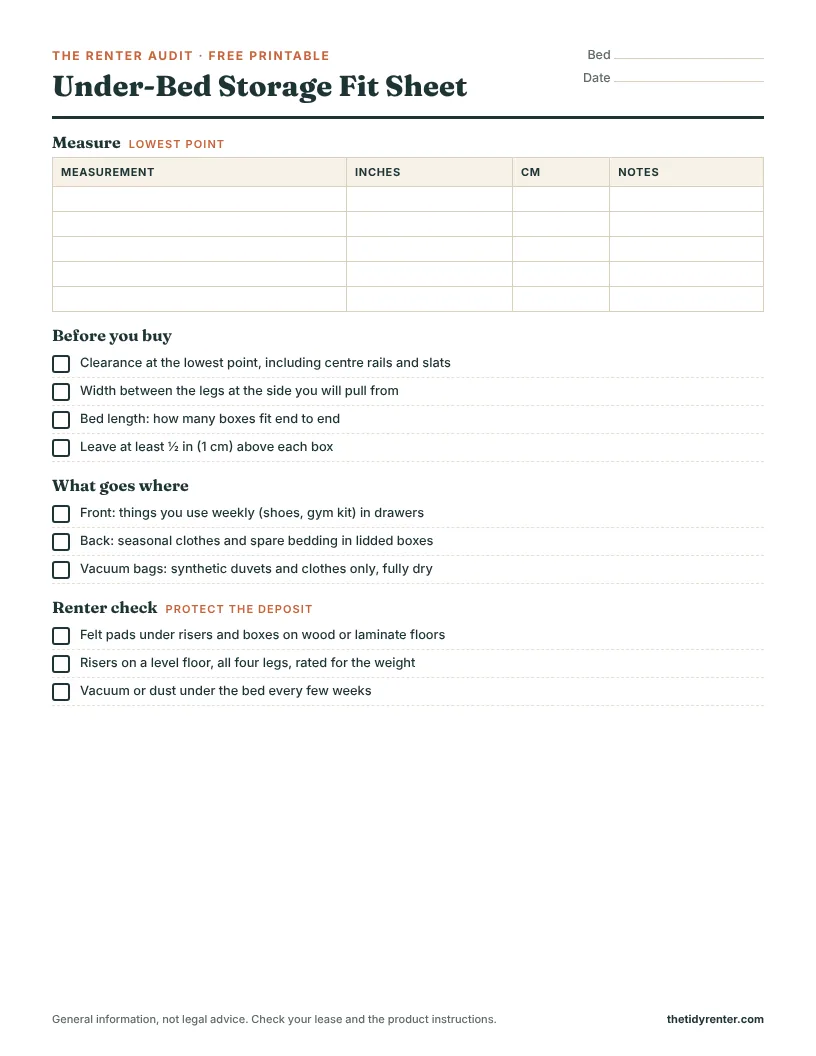
Free printable: Download the Under-Bed Storage Fit Sheet (PDF). Measure the gap in three places, check box sizes before you buy and plan what goes where.
Frequently asked questions
How much space do you need under a bed for storage?
At least 7 in (18 cm) for most low boxes. Measure to the lowest point of the frame and buy boxes at least ½ in (1 cm) lower than that.
What is the best under-bed storage?
Clear lidded boxes for seasonal clothes, rolling drawers for things you use weekly, and vacuum bags only for synthetic bedding and clothes.
Are bed risers safe?
Yes, if all four legs sit squarely in the risers on a level floor and the weight rating covers the bed, mattress and sleepers. Don’t use them under beds with wheels.
Can you vacuum-seal a down duvet?
It’s best not to. Professional organisers advise against compressing down, feathers and wool because it can damage the filling. Use a breathable bag instead.
How do I keep dust out of under-bed storage?
Use lidded boxes or zipped cases, vacuum under the bed every few weeks, and add a bed skirt if your bed is open underneath.
The bottom line: measure the lowest point under the bed, buy boxes that leave a little room, put weekly things at the front in drawers and seasonal things at the back in lidded boxes, and only vacuum-pack synthetics. If the gap is too small, risers are a cheap, renter-safe fix.
Related guides on The Tidy Renter
- Small Apartment Storage Ideas for Renters: no-drill storage for every room.
- Small Closet Organization Ideas That Actually Fit: double the hanging space without drilling.
- Small Bathroom Storage Ideas for Renters: storage for the smallest room in the flat.
Update log
- November 2026: First published. Sizes and prices checked.
Sources
- Apartment Therapy: under-bed storage solutions
- Walmart: Sterilite 41 qt underbed box (dimensions)
- IKEA UK: SKUBB storage case (dimensions)
- Ideal Home: should you use vacuum storage bags for duvets
Images: all graphics and the printable in this guide were designed by The Tidy Renter. No AI-generated images are used.
Prices are typical ranges and change often. This guide is general information; follow the product instructions for bed risers.