

Costs checked November 2026
Downsizing to a smaller apartment is mostly a measuring problem disguised as an emotional one. If you know exactly what fits in the new place, most decisions make themselves. If you don’t, you pay to move furniture that ends up blocking a doorway or sitting in a storage unit. This guide gives you a calm eight-week plan that starts with the floor plan, works room by room, and shows what moving and storage really cost in the US and UK, so you can decide what is worth taking.
Quick answer
Get the new floor plan with measurements eight weeks out, measure your big furniture, and mark what fits. Sort one room a week into keep, sell, donate and recycle, starting with the rooms you use least. List furniture for sale early, book a free charity collection for the rest, and get moving quotes based only on what you’re keeping. Use a storage unit only for things you will use within a year.
The De Auditor’s Tip
Ask the letting agent for the floor plan with measurements before you sign, or take a tape measure to the viewing. Measure the doorways and the turn into the bedroom too. Sofas rarely fail on floor space; they fail on the hallway.
How much smaller is your new place?
If you are moving from a house or a bigger flat, the numbers help set expectations. RentCafe’s 2025 figures put the average new US apartment at 910 sq ft (85 m²): about 460 sq ft (43 m²) for a studio, 735 sq ft (68 m²) for a one-bedroom and 1,095 sq ft (102 m²) for a two-bedroom (RentCafe).
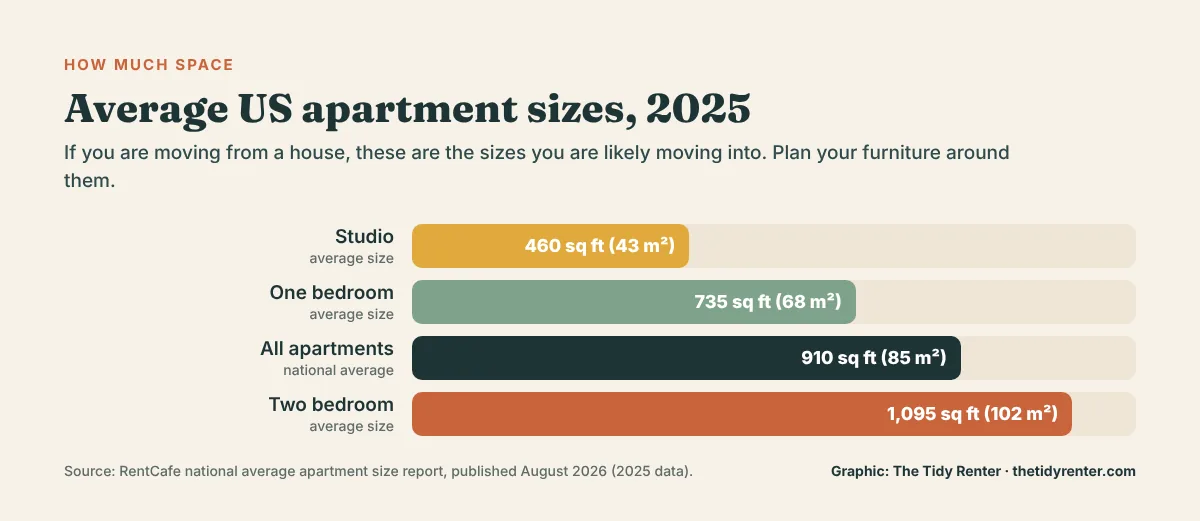
A one-bedroom of 735 sq ft has roughly the floor area of a living room, a bedroom, a kitchen and a bathroom in a small house, with no spare room, garage or loft. Everything that lived in those spaces needs a decision.
The 8-week downsizing plan
Weeks 8 to 7: plan on paper
| Renter Audit | |
|---|---|
| Cost | Free |
| Deposit risk | None |
| Impact | Very high. Every later decision depends on it |
| Effort | 2 to 3 hours |
- Get or draw the floor plan of the new apartment with room sizes, doors, windows, radiators and sockets.
- Measure your big pieces: sofa, bed, dining table, wardrobes, desk, bookcases. Write down width, depth and height.
- Draw them on the plan to scale, or tape their outlines on the floor of your current home and see what fits in a space the size of the new rooms.
- Anything that doesn’t fit, or only fits by blocking a 30 in (76 cm) walkway, goes on the decision list.
Our guides to small living room layouts and studio apartment layouts give the spacing to plan with.
Weeks 6 to 4: sort room by room
| Renter Audit | |
|---|---|
| Cost | Free |
| Deposit risk | None |
| Impact | High |
| Effort | One room per weekend |
Start with the rooms you use least, such as the spare room, garage or loft, because the decisions are easier and you build momentum. Leave the kitchen and your bedroom until last. Sort every item once into one of four piles.
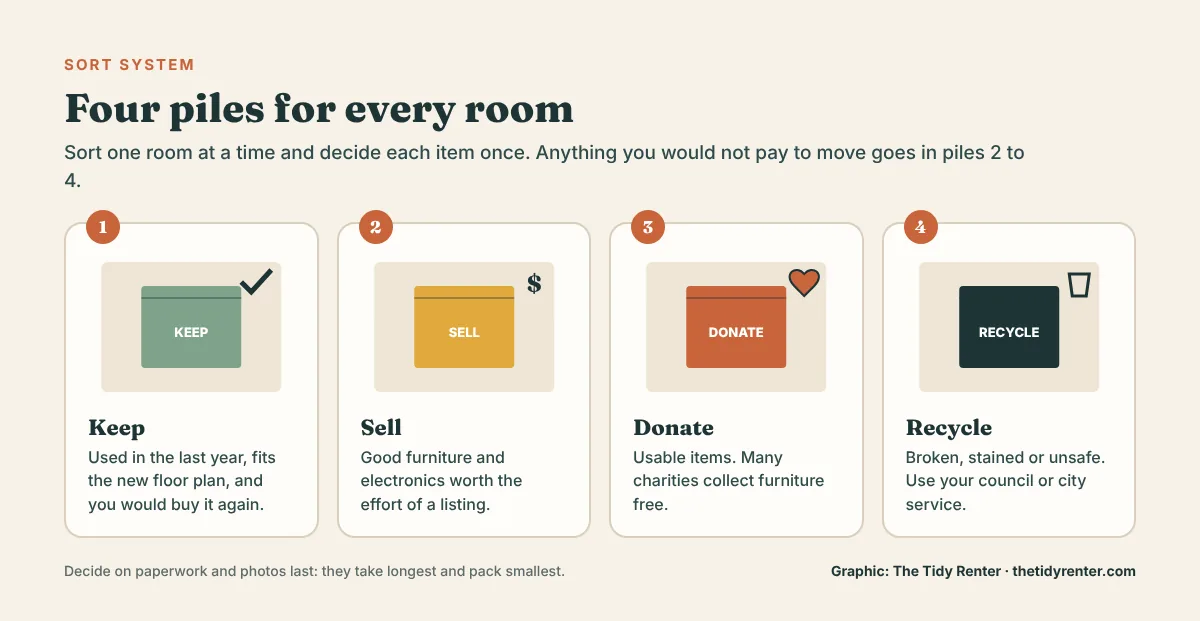
- Keep: used in the last year, fits the plan, and you would buy it again.
- Sell: furniture and electronics worth the time of a listing.
- Donate: usable items you don’t need.
- Recycle: broken, stained or unsafe.
Our room-by-room declutter guide has a free checklist that works well for this stage.

The De Auditor’s Note
Christian, founder of The Tidy Renter
The one rule that saves the most money in a downsize: if you wouldn’t pay to move it and wouldn’t pay to store it, you don’t really want it. Ask that question about every big piece before the movers quote, not after.
Weeks 4 to 2: sell, donate and book
| Renter Audit | |
|---|---|
| Cost | Free to list; collection usually free |
| Deposit risk | None |
| Impact | High. Smaller move, lower quote |
| Effort | A few hours a week |
Sell early. Furniture takes weeks to sell on local marketplaces. Price it to go, and take clear photos in daylight.
Donate with a free collection. In the US, many charities pick up furniture free, including most Habitat for Humanity ReStores, the Salvation Army and member furniture banks, though each local branch sets its own list of accepted items (MoveBuddha). In the UK, the British Heart Foundation collects furniture and electrical items free; upholstered items such as sofas and mattresses need a fire safety label attached, or the crew can’t take them (British Heart Foundation).
Book the movers once the keep pile is clear. Get three quotes based only on what is going.
Week 1: pack what fits
- Pack by room and label each box with the room it goes to in the new apartment, not the old one.
- Keep an essentials box: chargers, basic tools, bedding, a kettle, medicines and paperwork.
- Photograph your old home empty and clean before you hand back the keys, for the deposit. Our move-in checklist shows how to photograph the new place on day one.
What moving and storage cost
A smaller move costs less, which is the real financial benefit of deciding before you book.
| Cost | Typical figure | Source |
|---|---|---|
| US local move (all sizes) | About $1,697 on average; $876 to $2,550 typical range | HomeAdvisor |
| US local move, 1-bedroom home | About $400 average ($250 to $500) | HomeAdvisor |
| US movers’ hourly rate | $30 to $80 per mover per hour | HomeAdvisor |
| US storage unit, 5 x 10 ft | About $75 a month | Neighbor |
| US storage unit, 10 x 10 ft | About $120 a month, plus $30 to $75 for climate control | Neighbor |
| UK removal, 1-bedroom flat | From about £195 | AnyVan |
Storage adds up fast. A 10 x 10 ft unit at about $120 a month costs roughly $1,440 a year, which is more than many of the things inside it are worth. Use storage for a clear, short reason, such as a planned move to a bigger place within the year, not as a way to delay decisions.
The De Auditor’s Tip
Before you rent a storage unit, add up the year’s cost and compare it with what it would cost to replace what’s going in. If replacing is cheaper, sell or donate now and keep the cash. Sentimental items are the exception, and they usually fit in one or two boxes.
Making the most of a small apartment after the move
- Choose dual-use furniture: a storage ottoman, a bed with drawers, an extendable table.
- Go vertical: tall bookcases, over-door storage and freestanding shelves. Our small apartment storage guide has no-drill ideas with fit maths.
- Keep the one in, one out rule for the first year. It stops the new place filling up again.
In the UK and Ireland
UK flats are often smaller than US apartments, and many have no storage at all beyond a hall cupboard. Measure the stairwell and any lift if you are moving furniture into an upper-floor flat. Charity collections from the British Heart Foundation and other charities are free but need a fire safety label on upholstered furniture. Councils collect bulky waste for a fee; check your council’s website for the price and booking times. If you’re a tenant leaving a rental, give notice in writing as your tenancy agreement requires, and book the check-out inspection.
What I’d skip
- Moving everything and sorting at the other end. You pay to move things you then throw away, and the new place is chaos for months.
- A storage unit “just for now”. Without an end date, it becomes a monthly bill for things you’ve forgotten.
- Keeping furniture for a future bigger home. Unless that move is within a year, sell it and buy what fits the next place when you get there.

The De Auditor’s Note
Christian, founder of The Tidy Renter
Downsizing is emotional, and it’s normal for the decisions to feel heavier than the furniture. If you get stuck, photograph the things you are letting go of. A photo keeps the memory without the square footage, and that usually makes the decision easier.
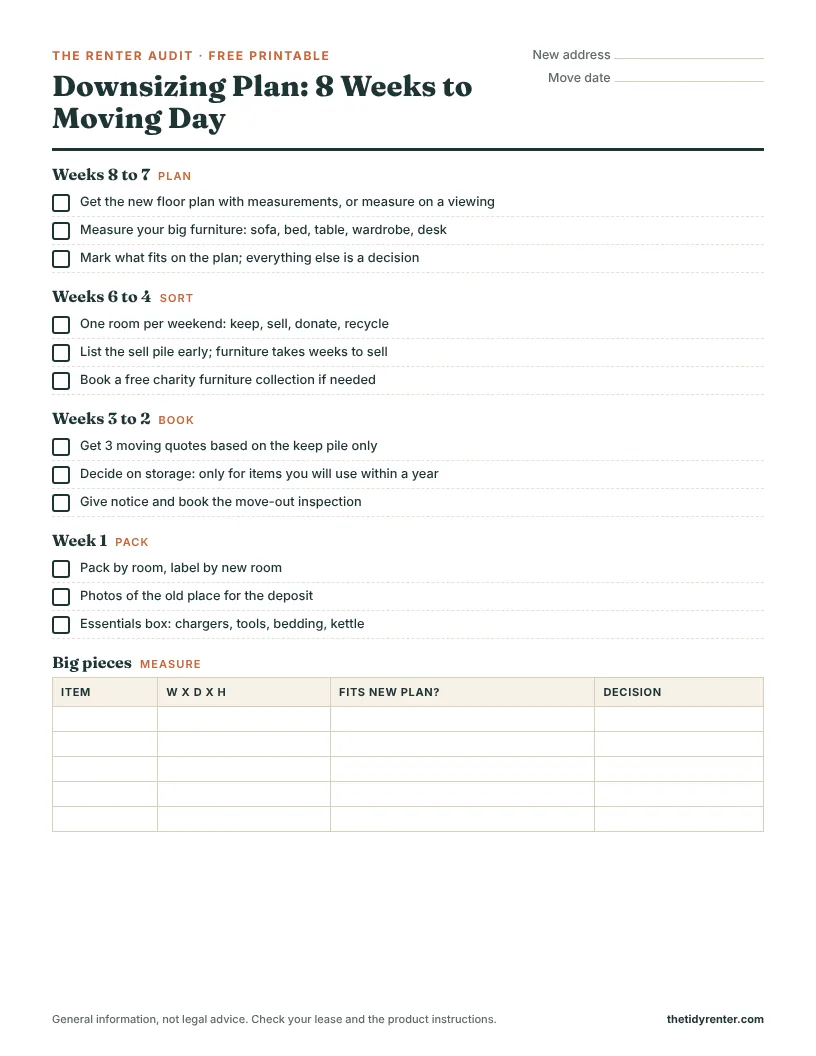
Free printable: Download the Downsizing Plan: 8 Weeks to Moving Day (PDF). A week-by-week checklist and a table to measure your big furniture against the new floor plan.
The De Auditor’s Note
Christian, founder of The Tidy Renter
I’ve gone from a bedsitter to a room and parlour and now a flat, and every move taught me the same thing: measure the new place before you decide what to keep. Furniture that fits in your head often won’t fit through the door.
Frequently asked questions
How do I start downsizing to an apartment?
Get the new floor plan with measurements, measure your big furniture and mark what fits. Then sort one room at a time into keep, sell, donate and recycle, starting with the rooms you use least.
How long does it take to downsize?
Plan for about eight weeks for a typical home. That allows time to sell furniture, book charity collections and get moving quotes based on the smaller load.
What size is an average one-bedroom apartment?
About 735 sq ft (68 m²) in the US, according to RentCafe’s 2025 data. A studio averages about 460 sq ft (43 m²).
Should I put things in storage when I downsize?
Only for a clear, short reason. A 10 x 10 ft unit costs about $120 a month in the US, so it often costs more over a year than the items are worth.
Who will collect furniture for free?
In the US, many Habitat for Humanity ReStores, the Salvation Army and furniture banks offer free pickup. In the UK, the British Heart Foundation collects furniture free; upholstered items need a fire safety label.
The bottom line: start with the floor plan and a tape measure, decide room by room, sell and donate early, and only move and store what fits the new life. The less you take, the cheaper the move and the easier the new place is to live in.
Related guides on The Tidy Renter
- How to Declutter Your Home Room by Room: a free checklist for the sorting stage.
- Studio Apartment Layout Ideas: measured floor plans for one-room living.
- Move-In Checklist for Renters: protect your deposit in the new place from day one.
Update log
- November 2026: First published. Costs checked.
Sources
- RentCafe: national average apartment size (2025 data)
- HomeAdvisor: how much do movers cost
- Neighbor: average storage unit prices
- AnyVan: removal costs for a 1-bedroom flat
- British Heart Foundation: free furniture collection
- MoveBuddha: charities that offer free donation pickup
Images: all graphics and the printable in this guide were designed by The Tidy Renter. No AI-generated images are used.
Costs are averages and vary by location and season. Get written quotes before booking. This guide is general information, not financial or legal advice.