

Prices checked November 2026
Most rentals come with one harsh ceiling light per room and nothing else. It makes everything look flat, and it is the first thing that makes a rental feel like a rental. The good news is that lighting is one of the easiest things to fix without touching the walls or the wiring. This guide covers 11 renter-friendly lighting ideas, how many lumens each room needs, which bulbs to buy and how to stay safe with cords.
Quick answer
Leave the ceiling light off in the evening and light each room from three lamps at different heights. Use warm white bulbs (2200 to 3000K) in living areas, buy by lumens, not watts (800 lumens replaces an old 60 W bulb), and add plug-in or rechargeable wall lights where you need light but have no table. Never change a hard-wired fitting without written permission and a qualified electrician.
The De Auditor’s Tip
Before you buy anything, stand in each room at night with only the ceiling light on and note the dark corners. Those corners are where your lamps go. Most rooms need light in two or three spots you’d never notice in daylight.
At a glance: every idea compared
| Idea | Typical cost | Deposit risk | Impact |
|---|---|---|---|
| 1. Three lamps at three heights | $15 to $90 a lamp | None | High |
| 2. Swap to warm LED bulbs | $ a bulb | None | High |
| 3. Get the brightness right (lumens) | Free | None | High |
| 4. Smart bulbs you can dim | $6 to $14 a bulb | None | Medium |
| 5. Plug-in wall lamps | $$ | Low (small screws or strips) | High |
| 6. Rechargeable lamps and wall lights | $14 to $35 | None to low | Medium |
| 7. A plug-in pendant (cord set) | $11 to $20 plus a shade | Low (ceiling hook) | High |
| 8. Under-cabinet and closet LED strips | $20 to $45 | Low | Medium |
| 9. Change the ceiling shade, not the fitting | $ to $$ | Low | Medium |
| 10. Mirrors and pale textiles | $ to $$ | None | Medium |
| 11. Ask the landlord to upgrade a fitting | Often free | None with written consent | High |
Cost bands: $ = under $25 / £20 · $$ = $25 to $100 / £20 to £80 · $$$ = over $100 / £80. Prices are from IKEA US unless stated.
Before you start: what renters can and can’t change
- Lamps, bulbs and anything that plugs in are yours to change. They need no permission.
- Hard-wired fittings (ceiling lights, wired wall lights) are part of the property. In New York, one property manager told Brick Underground the answer to “can I swap the light fixture?” is typically no, and that if a tenant does it anyway, they must store the original and put it back before moving out (Brick Underground).
- In the UK, most tenancy agreements require consent for alterations, and electrical work should be done by a qualified electrician. Ask by email and keep the reply.
1. Light each room from three lamps at three heights
| Renter Audit | |
|---|---|
| Cost | IKEA TÅGARP floor uplighter was $14.99; RÖDFLIK floor/reading lamp $59.99; LAUTERS floor lamp $79.99 |
| Deposit risk | None |
| Impact | High. The single biggest change to how a room feels |
| Effort | 10 minutes |
A single overhead light flattens a room and throws shadows under your eyes. Light from several lower points feels warmer and makes the room look bigger. The simple rule is three lamps at three heights:
- High: a floor lamp or uplighter in a corner, bouncing light off the ceiling.
- Middle: a table lamp beside the sofa or bed.
- Low or accent: a small lamp on a shelf, a rechargeable lamp or an LED strip.
You don’t need to spend much. At IKEA US, the TÅGARP floor uplighter was $14.99, the RÖDFLIK floor and reading lamp $59.99 and the LAUTERS floor lamp $79.99 (IKEA US).
2. Swap every bulb for a warm LED
| Renter Audit | |
|---|---|
| Cost | $ a bulb |
| Deposit risk | None. Keep the landlord’s old bulbs in a bag |
| Impact | High |
| Effort | 15 minutes for the whole home |
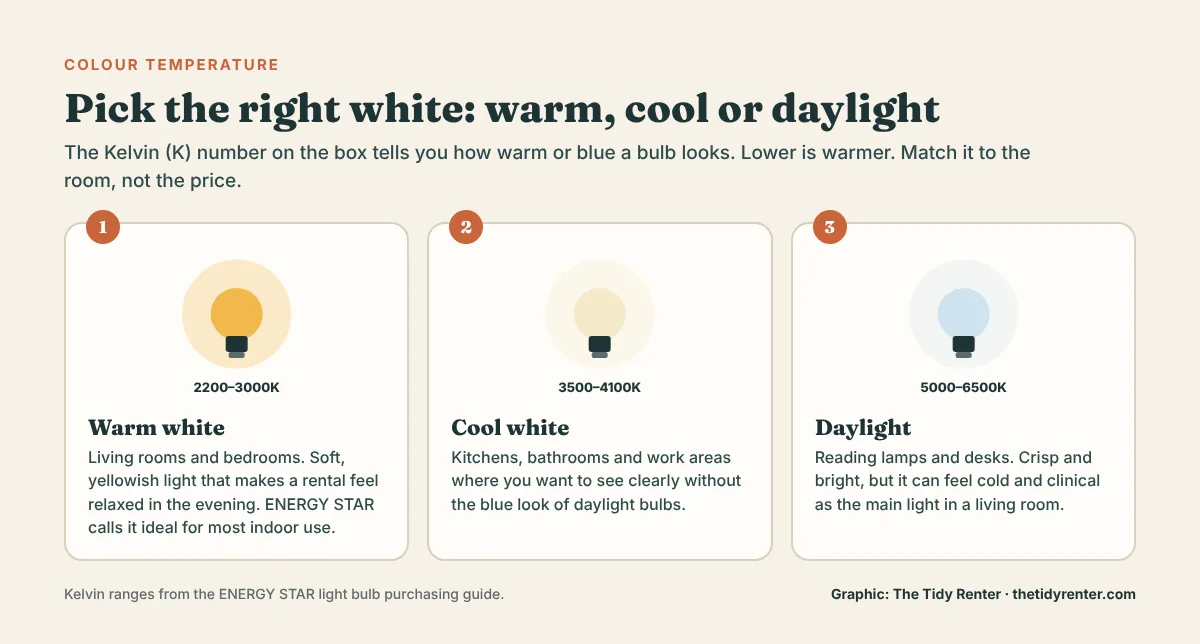
Many rentals come with cold, bluish bulbs. Swapping them is the cheapest big upgrade there is. Look at the Kelvin (K) number on the box. ENERGY STAR describes warm white (about 2200 to 3000K) as ideal for most indoor rooms, cool white (3500 to 4100K) as good for kitchens and work spaces, and daylight (5000 to 6500K) as good for reading (ENERGY STAR).
Check the base: US lamps mostly take E26 (medium screw) bulbs. In the UK you’ll find E27 screw and B22 bayonet bases, and small spotlights often take GU10. Take the old bulb to the shop if you’re not sure.
3. Get the brightness right: buy by lumens, not watts
| Renter Audit | |
|---|---|
| Cost | Free |
| Deposit risk | None |
| Impact | High. Too dim feels gloomy; too bright feels like an office |
| Effort | 5 minutes with a tape measure |
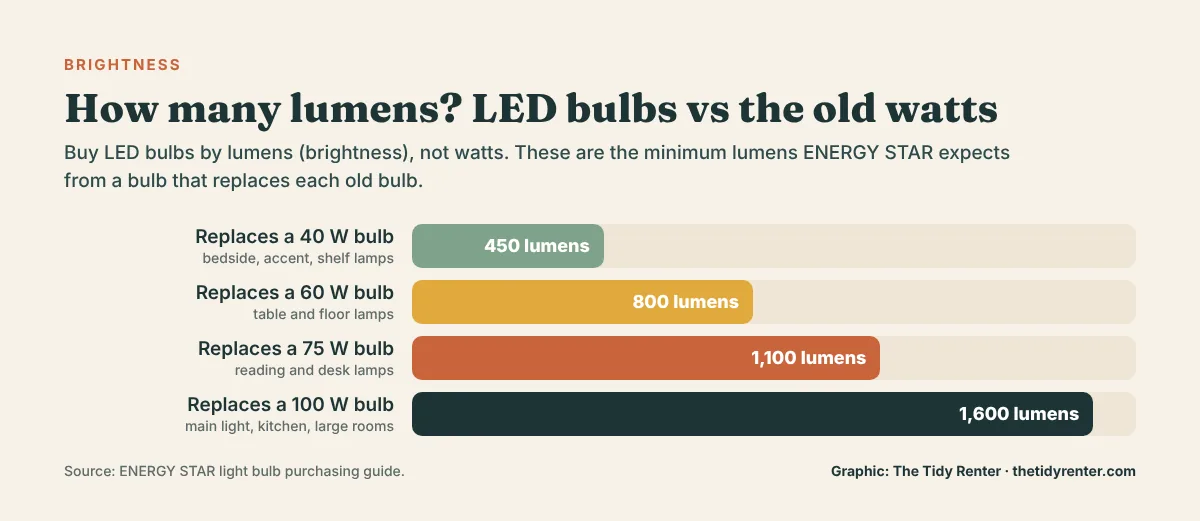
LED bulbs use far fewer watts than old bulbs, so watts no longer tell you how bright a bulb is. Lumens do. ENERGY STAR’s minimums for replacement bulbs are 450 lumens for an old 40 W bulb, 800 for 60 W, 1,100 for 75 W and 1,600 for 100 W (ENERGY STAR).
How much light does a room need? One foot-candle is one lumen per square foot. Home Depot suggests about 10 to 20 foot-candles for a living room and 60 to 80 for a home office work area (Home Depot). So:
- A 10 x 12 ft (3 x 3.7 m) living room is 120 sq ft and needs about 1,200 to 2,400 lumens in total.
- That’s roughly two 800-lumen lamps and one 450-lumen accent light, or three 800-lumen lamps for a brighter room.
- For a desk, add a dedicated task lamp rather than turning the whole room up.

The De Auditor’s Note
Christian, founder of The Tidy Renter
The mistake I see most in rentals isn’t too little light, it’s the wrong kind. A 5000K daylight bulb in a living room makes even a nice sofa look like a waiting room. If your place feels cold at night, check the Kelvin number on your bulbs before you buy a single new lamp.
4. Use smart bulbs to dim without a dimmer switch
| Renter Audit | |
|---|---|
| Cost | IKEA KAJPLATS smart bulbs from $5.99 (450 lumens) to $13.99 (1,600 lumens); starter kits from $9.99 |
| Deposit risk | None |
| Impact | Medium. Turns one bright light into a soft evening light |
| Effort | 10 minutes to set up |
You can’t add a dimmer switch to a rental without permission, but you can put the dimmer in the bulb. Smart bulbs screw into a normal lamp or ceiling socket and let you dim them or change the colour temperature from an app or remote. IKEA’s KAJPLATS range, for example, ran from $5.99 for a 450-lumen E26 bulb to $13.99 for a 1,600-lumen one (IKEA US).
A smart bulb in the main ceiling light is a good trick for renters: bright and cool when you clean, warm and low in the evening, with nothing changed on the wall. Keep the original bulbs to put back when you leave.
5. Add plug-in wall lamps
| Renter Audit | |
|---|---|
| Cost | $$ for most wall lamps |
| Deposit risk | Low. Two small screws or heavy-duty strips, plus a removable cord cover |
| Impact | High. Light where there’s no room for a table |
| Effort | 20 to 30 minutes |
Wall lights look built-in, but a plug-in wall lamp has a cord that runs down the wall to a normal socket, so there’s no wiring involved. They’re ideal beside a bed with a narrow nightstand, or above a sofa where there’s no space for a floor lamp.
- Mounting: most need one or two small screws. If your lease bans holes, check the lamp’s weight against heavy-duty picture-hanging strips. Our guide to hanging things without damaging rental walls explains weight limits.
- The cord: run it straight down and hide it in a paintable cord cover. Choose one with removable adhesive, and test it in a hidden spot first.
- Check the listing says it plugs in. Some wall lamps are hard-wired only, and those need an electrician.
6. Use rechargeable lamps and wall lights
| Renter Audit | |
|---|---|
| Cost | IKEA LAMPAN portable lamp $13.99; NÖDMAST $14.99; TVÅMASTAD $29.99 |
| Deposit risk | None to low |
| Impact | Medium |
| Effort | 5 minutes, then charge as needed |
Battery lamps go anywhere: a bookshelf, a dining table, a dark hallway or a balcony. IKEA’s battery-operated portable lamps ranged from $13.99 (LAMPAN) and $14.99 (NÖDMAST) to $29.99 (TVÅMASTAD) (IKEA US).
Rechargeable wall sconces work the same way: a battery bulb that charges by USB, with no cord at all. They’re a good choice where there’s no socket, but you’ll be recharging them about once a week if you use them every evening.
7. Hang a plug-in pendant
| Renter Audit | |
|---|---|
| Cost | IKEA HAVSRIS cord set with switch was $20; STRÅLA cord set $17.99; plus a shade |
| Deposit risk | Low. One ceiling hook, which needs permission |
| Impact | High. A statement light over a table or in a corner |
| Effort | 30 minutes |
A plug-in pendant is a cord set with a plug at one end and a bulb holder at the other. You loop the cord across the ceiling on a hook and let it drop where you want light, usually over a dining table or into a dark corner. IKEA’s cord sets ranged from about $11 to $20, including the HAVSRIS cord set with a switch on a 15 ft 5 in cord (IKEA US).
The ceiling hook is a small hole, so ask your landlord first, and fill it when you leave. Keep the cord where nobody can catch it.
8. Add LED strips under cabinets and in closets
| Renter Audit | |
|---|---|
| Cost | IKEA KÖLVATTEN battery light with sensor $20; MITTLED countertop strip $26; KABBLEKA USB strip $24.99 |
| Deposit risk | Low. Strips stick to the underside of cabinets, not walls |
| Impact | Medium. Proper task light for cooking |
| Effort | 20 minutes |
Most rental kitchens have a ceiling light behind you, so you cook in your own shadow. LED strips under the wall cabinets put light straight onto the counter. IKEA sold the MITTLED dimmable countertop strip at $26, the battery-powered KÖLVATTEN with a motion sensor at $20, and the USB-powered KABBLEKA strip at $24.99 (IKEA US).
- Battery and sensor lights are the easiest in a rental because there are no cords at all, and they’re useful inside dark closets too.
- Stick strips to the underside of cabinets, not to painted walls. Adhesive can lift paint when you remove it.
For more kitchen ideas, see our small kitchen organization guide.
9. Change the ceiling shade, not the fitting
| Renter Audit | |
|---|---|
| Cost | $ to $$ |
| Deposit risk | Low. Keep the original shade |
| Impact | Medium |
| Effort | 15 minutes |
If the ceiling light has a simple bulb holder, you can often swap a bare bulb or ugly shade for a paper lantern or fabric shade without touching any wiring. Turn the power off at the switch, let the bulb cool, and follow the shade’s instructions. Keep the original shade in a labelled bag so you can put it back. If the fitting is a sealed dome or anything that needs unscrewing from the ceiling, leave it to the landlord.
10. Make the light go further with mirrors and pale textiles
| Renter Audit | |
|---|---|
| Cost | $ to $$ |
| Deposit risk | None. Lean mirrors rather than hanging them |
| Impact | Medium |
| Effort | 10 minutes |
A large mirror opposite a window or lamp bounces light back into the room, and pale cushions, throws and rugs reflect more light than dark ones. Lean a floor mirror against the wall instead of hanging it, and use felt pads where it touches. Our renter-friendly decor guide has more ideas that don’t touch the walls.
11. Ask your landlord to upgrade a fitting
| Renter Audit | |
|---|---|
| Cost | Often free if the landlord pays; otherwise the cost of the fitting |
| Deposit risk | None with written consent |
| Impact | High |
| Effort | One email |
If a room really needs a better ceiling light, ask. Some landlords will install a fitting you choose, or let you pay a qualified electrician to fit it as long as you keep the original. Put the request in writing, name the room and the fitting you’d like, and offer to put the original back when you leave.
The De Auditor’s Tip
Keep every original bulb, shade and cover in one labelled bag, and take a photo of each light before you change anything. On move-out day you can put the place back exactly as you found it in ten minutes.
Stay safe with cords and plugs
More lamps means more cords. A few rules keep them safe:
- Never run cords under rugs or furniture, and don’t nail or staple them to walls or skirting boards. The US Electrical Safety Foundation (ESFI) warns this damages the insulation (ESFI).
- Don’t plug one extension cord into another, and use extension cords as a temporary fix, not a permanent one.
- Look for a safety mark: UL, ETL or CSA in the US. In the UK, Electrical Safety First advises never plugging appliances that together draw more than 13 amps (3,000 watts) into one extension lead or socket (Electrical Safety First). LED lamps use very little power, so lamps alone are rarely a problem; heaters and kettles are.

The De Auditor’s Note
Christian, founder of The Tidy Renter
If your rental has one socket in the whole living room, don’t solve it with a chain of power strips. Tell your landlord in writing. Too few sockets is their problem to fix, and a written request protects you if anything goes wrong later.
What I’d skip
- Changing a hard-wired fitting yourself. It needs permission and, in most places, a qualified electrician.
- Daylight bulbs in living rooms and bedrooms. Save them for desks and reading.
- Sticking LED strips straight onto painted walls. The adhesive can take paint with it.
- Cheap, unmarked cords and plugs from marketplace sellers with no safety mark.
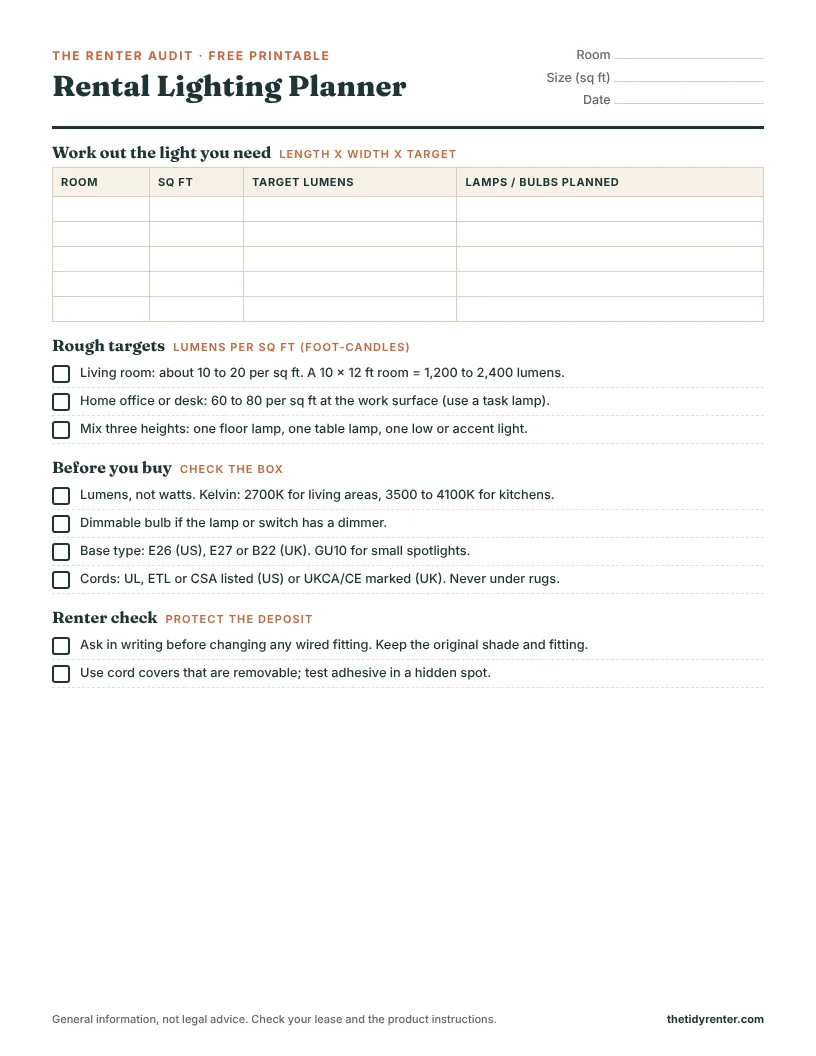
Free printable: Download the Rental Lighting Planner (PDF). Work out the lumens each room needs, plan your lamps and check bulbs before you buy.
Frequently asked questions
How can I improve lighting in my apartment without hardwiring?
Use floor and table lamps at different heights, warm LED bulbs, plug-in or rechargeable wall lights, smart bulbs for dimming and LED strips under kitchen cabinets. None of these need an electrician.
Can I change the light fixture in my rental?
Only with your landlord’s written permission, and a hard-wired fitting should be changed by a qualified electrician. If you’re allowed, keep the original and put it back before you move out.
What colour temperature is best for a living room?
Warm white, about 2200 to 3000K. ENERGY STAR describes warm white as ideal for most indoor rooms. Use cool white (3500 to 4100K) in kitchens and work areas.
How many lumens do I need for a living room?
Roughly 10 to 20 lumens per square foot. A 120 sq ft living room needs about 1,200 to 2,400 lumens in total, spread across several lamps.
Are plug-in wall sconces safe?
Yes, if the lamp and cord carry a recognised safety mark, the cord isn’t pinched or run under a rug, and you don’t overload the socket. Hide the cord in a cord cover rather than stapling it.
Do smart bulbs work in any lamp?
They work in most standard lamps and ceiling sockets with the right base (E26 in the US, E27 or B22 in the UK). Don’t use them with an existing wall dimmer unless the bulb says it’s compatible.
The bottom line: turn off the ceiling light, add three lamps at three heights, buy warm LED bulbs by lumens, and use plug-in or rechargeable lights where you need more. Keep every original part, and leave the wiring to the landlord.
Related guides on The Tidy Renter
- Renter-Friendly Decor Ideas That Won’t Cost Your Deposit: curtains, rugs, textiles and more, with the deposit risk of each.
- Studio Apartment Layout Ideas: use rugs and lamps to create zones in one room.
- Small Kitchen Organization Ideas for Renters: no-drill storage and under-cabinet ideas.
Update log
- November 2026: First published. Prices checked.
Sources
- ENERGY STAR: light bulb purchasing guide (PDF)
- Home Depot: how to estimate lumens for your space
- Brick Underground: landlord permission for upgrades
- The Homes I Have Made: changing light fixtures in a rental
- ESFI: cord-related hazards
- Electrical Safety First: overloading sockets
- IKEA US: floor lamps, portable lamps, smart bulbs, cord sets and LED strips
Images: all graphics and the printable in this guide were designed by The Tidy Renter. No AI-generated images are used.
This guide is general information. Follow the manufacturer’s instructions, and get written permission and a qualified electrician for any change to wired fittings.