

Prices and sizes checked November 2026
Most rental closets are built the same way: one rod, one shelf above it, and a dark floor where shoes go to disappear. That layout wastes the space under short clothes and the air above the shelf. This guide shows you how to edit a small closet first, then how to double the hanging space and use the shelf, the door and the floor properly, all without drilling a single hole.
Quick answer
Edit first: take everything out and keep only what fits and has been worn in the last year. Then add a hanging rod extender to create a second rod for shirts and folded trousers, switch to matching slim hangers, use shelf dividers or bins on the top shelf, put shoes on an over-door rack, and move off-season clothes under the bed. A standard reach-in closet is about 24 in (61 cm) deep; measure yours before buying any organiser.
The De Auditor’s Tip
Turn every hanger backwards when you organise the closet. Each time you wear something and hang it back, turn its hanger the right way. After six months, anything still on a backwards hanger is a clear candidate to donate, and you didn’t have to guess.
Step 1: Edit before you organise
| Renter Audit | |
|---|---|
| Cost | Free |
| Deposit risk | None |
| Space gain | High. Often frees a quarter of the rod |
| Effort | An afternoon |
Organising things you don’t wear just makes a tidier mess. Take everything out of the closet, wipe the shelf and rod, and sort into four piles:
- Keep: fits now and worn in the last 12 months.
- Store elsewhere: off-season clothes, suitcases, special-occasion outfits.
- Donate or sell: doesn’t fit, not worn, duplicates of things you already have.
- Repair: one small bag, with a deadline. If it isn’t fixed in a month, it goes.
Our room-by-room guide on how to declutter your home has a free checklist for the rest of the flat.
Step 2: Measure your closet
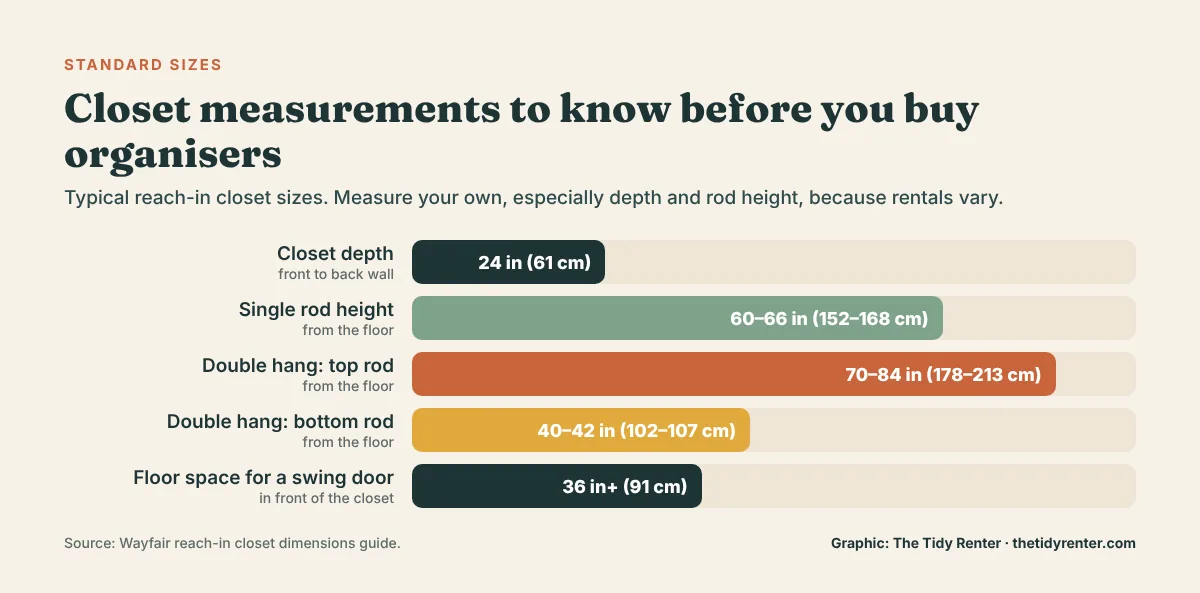
Rental closets vary, so measure before you buy anything. Wayfair’s guide gives these typical reach-in sizes (Wayfair):
- Depth: about 24 in (61 cm). At 20 to 22 in (51 to 56 cm), hangers may hit the back wall, so tiered hangers or hanging cubes work better.
- Single rod height: 60 to 66 in (152 to 168 cm) from the floor.
- Double hang: top rod at 70 to 84 in (178 to 213 cm), bottom rod at about 40 to 42 in (102 to 107 cm).
- Floor space in front: at least 36 in (91 cm) for a swinging door, 24 in (61 cm) for folding doors.
Step 3: Choose a layout
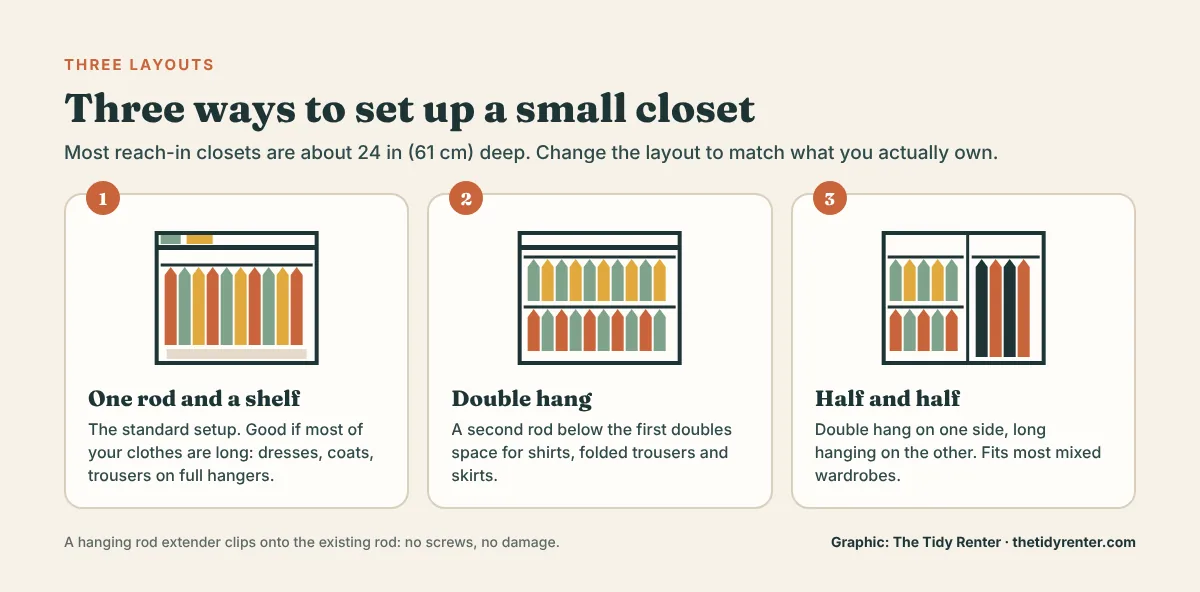
Look at what you own after the edit. If most of it is long (dresses, coats, trousers hung full length), keep one rod. If most of it is short (shirts, blouses, folded trousers, skirts), a second rod doubles your space.
1. A hanging rod extender (double hang without tools)
| Renter Audit | |
|---|---|
| Cost | $15 to $30 / £12 to £25 |
| Deposit risk | None. It hooks over the existing rod |
| Space gain | Very high. Up to double the hanging space for short clothes |
| Effort | 2 minutes |
A rod extender hangs from your existing rod on two hooks and adds a second rod about 3 ft (90 cm) below it. Shirts go on top, folded trousers and skirts below. Most are adjustable in height. Check the weight limit, because the second rod pulls on the first: if your existing rod already sags, don’t add one until the landlord fixes it.
2. Matching slim hangers
| Renter Audit | |
|---|---|
| Cost | $20 to $35 for 50 / £15 to £25 |
| Deposit risk | None |
| Space gain | High. More garments on the same rod |
| Effort | 30 minutes |
Mixed wire, plastic and wooden hangers waste space and tangle. Slim velvet hangers are thinner than most wooden ones, and the flocked surface stops clothes sliding off. Use one style for everything so the closet reads as one neat line. Keep a few sturdy wooden hangers for heavy coats and suits, which can stretch on slim ones.
3. Shelf dividers and bins on the top shelf
| Renter Audit | |
|---|---|
| Cost | $15 to $40 / £10 to £30 |
| Deposit risk | None. Clip-on dividers don’t need screws |
| Space gain | Medium. Stops piles toppling |
| Effort | 15 minutes |
The shelf above the rod is usually deep and high, which is why piles slump into each other. Clip-on acrylic or wire dividers keep jumpers and jeans in neat stacks. For the far back and the top, use lidded fabric bins with a label at the front, and keep things you rarely use there.

The De Auditor’s Note
Christian, founder of The Tidy Renter
Knitwear shouldn’t live on hangers in a closet you’re trying to save space in. The shoulders stretch, and bulky jumpers take up three times the rod space of a shirt. Folded on a divided shelf, they last longer and the rod is free for clothes that need hanging.
4. An over-door shoe or accessory rack
| Renter Audit | |
|---|---|
| Cost | $20 to $80 / £15 to £60 |
| Deposit risk | Low. Add felt pads where it touches the door |
| Space gain | High. Takes shoes off the closet floor |
| Effort | 10 minutes |
Shoes are what usually fills a closet floor. An over-door rack on the inside of the closet or bedroom door holds them at eye level. Fabric pocket organisers are cheapest; metal basket systems are sturdier. Apartment Therapy’s review of the ClosetMaid metal over-door organiser notes it is 77.5 in (197 cm) tall and comes with eight adjustable baskets (Apartment Therapy). Check that the door still closes fully once the rack is on.
5. Hanging shelves and cubbies
| Renter Audit | |
|---|---|
| Cost | $15 to $30 / £10 to £25 |
| Deposit risk | None |
| Space gain | Medium. Adds shelves inside the hanging space |
| Effort | 2 minutes |
A fabric hanging organiser with five or six cubbies hangs from the rod with Velcro straps. It turns one section of rod into shelves for T-shirts, gym kit, bags or folded jeans. In a shallow closet, it’s often the best option because nothing sticks out sideways.
6. Use the closet floor properly
| Renter Audit | |
|---|---|
| Cost | $20 to $60 / £15 to £45 |
| Deposit risk | Low. Felt pads on wooden floors |
| Space gain | Medium |
| Effort | 20 minutes |
Under short clothes there’s usually 30 in or more of free floor height. A two-tier shoe shelf, a small chest of drawers that fits under the hems, or a laundry basket all work there. Measure the width between the side walls and the height to the lowest hem first.
7. A freestanding clothes rack for overflow
| Renter Audit | |
|---|---|
| Cost | $40 to $120 / £30 to £90 |
| Deposit risk | None |
| Space gain | High if you have floor space |
| Effort | 20 minutes |
If the closet simply isn’t big enough, a freestanding rack in the bedroom adds a whole extra rod. Double-rod versions are like a second closet: one Whitmor model measures 68 in high, 45¼ in wide and 19½ in deep (Lowe’s listing). A cover keeps dust off and hides the clothes.
8. Hooks on the inside walls
| Renter Audit | |
|---|---|
| Cost | $10 to $20 / £8 to £15 |
| Deposit risk | Low if removed correctly |
| Space gain | Low to medium |
| Effort | 5 minutes, plus waiting time |
The short side walls inside the closet are usually empty. Removable adhesive hooks hold belts, scarves, bags and tomorrow’s outfit. Stay within the weight on the pack, and remove them by stretching the tab straight down at move-out: our guide on removing Command strips without damaging paint shows how.
The De Auditor’s Tip
Put a battery puck light with a motion sensor on the shelf or inside wall of a dark closet. You’ll stop buying duplicates of things you couldn’t see, and it comes off with no wiring at all.
9. Move off-season clothes out
| Renter Audit | |
|---|---|
| Cost | $10 to $30 / £7 to £25 |
| Deposit risk | None |
| Space gain | High. Often frees a third of the closet |
| Effort | An hour, twice a year |
Twice a year, move the off-season wardrobe under the bed or to the top of the closet in lidded boxes. Vacuum bags save the most space for synthetic clothes, but organisers quoted by Ideal Home advise against compressing down, feathers, wool, leather and silk (Ideal Home). Store everything clean and fully dry. Low lidded boxes under the bed are the best place for them in most small flats.
In the UK and Ireland
Many UK and Irish rentals have a freestanding or fitted wardrobe instead of a built-in closet. The same rules apply: edit first, then use a rod extender, matching slim hangers, shelf dividers and a hanging organiser. Most fitted wardrobes are about 60 cm deep, so check the rod-to-door space before adding anything that sticks out. Don’t screw extra rails or shelves into a landlord’s wardrobe without written permission; it is the landlord’s furniture and part of the inventory.
What I’d skip
- Cascading hangers that stack five garments vertically. They save rod space, but you can’t see or reach the middle items, so they turn into storage for things you don’t wear.
- Tension-rod shelving systems in a deep closet. They hold well in narrow spaces, but in a wide closet the bar can bow and slip.
- Buying organisers before editing. You’ll buy for clothes you then give away.

The De Auditor’s Note
Christian, founder of The Tidy Renter
The best closet upgrade in most rentals costs nothing: getting rid of the clothes you keep “just in case”. I’d rather see a half-empty rod with everything visible than a full one where you wear the same ten things on the front.
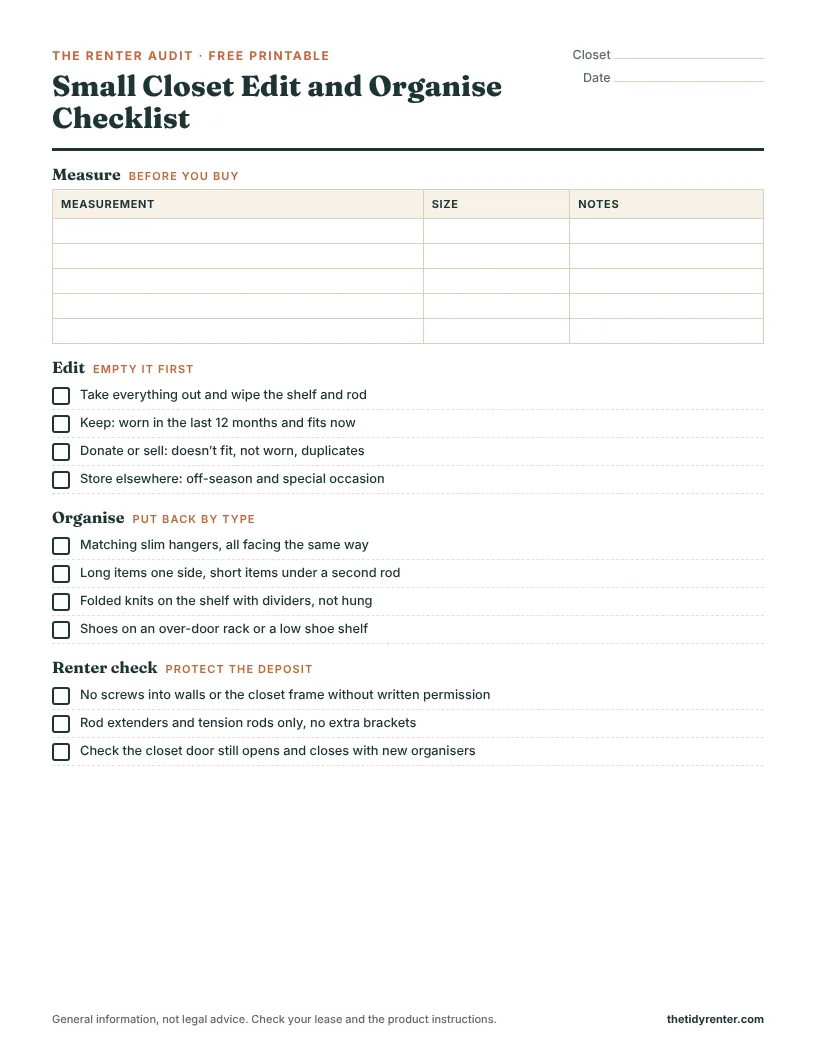
Free printable: Download the Small Closet Edit and Organise Checklist (PDF). Measure, edit and put back by type, with a renter check at the end.
Frequently asked questions
How do I maximise space in a small closet?
Edit first, then add a second rod with a rod extender, use matching slim hangers, divide the top shelf, move shoes onto an over-door rack and store off-season clothes elsewhere.
How deep is a standard closet?
About 24 in (61 cm) for a reach-in closet. Closets of 20 to 22 in (51 to 56 cm) are tight for standard hangers.
How high should a double closet rod be?
The top rod usually sits at 70 to 84 in (178 to 213 cm) and the bottom rod at about 40 to 42 in (102 to 107 cm).
Can I organise a rental closet without drilling?
Yes. Rod extenders, clip-on shelf dividers, hanging organisers, over-door racks, freestanding shelves and removable adhesive hooks all work without screws.
Should I hang or fold sweaters?
Fold them. Hanging stretches the shoulders and uses far more rod space than folding them on a divided shelf.
The bottom line: edit first, measure, then add a second rod, matching slim hangers and shelf dividers. Get shoes off the floor and off-season clothes out of the closet, and a small rental closet will hold far more than you expect.
Related guides on The Tidy Renter
- How to Declutter Your Home Room by Room: a plan and free checklist for every room.
- Small Apartment Storage Ideas for Renters: no-drill storage across the whole flat.
- No-Drill Shelves for Renters: shelves that hold without screws.
Update log
- November 2026: First published. Sizes and prices checked.
Sources
- Wayfair: reach-in closet dimensions guide
- Apartment Therapy: ClosetMaid over-door organizer review
- Lowe’s: Whitmor double-rod freestanding closet (dimensions)
- Ideal Home: should you use vacuum storage bags for duvets
Images: all graphics and the printable in this guide were designed by The Tidy Renter. No AI-generated images are used.
Prices are typical ranges and change often. This guide is general information; check your lease before fixing anything to walls or furniture.