

Checked October 2026
Clutter is the reason a small rental feels smaller than it is. Before you buy another storage box, it’s worth getting rid of what you don’t use. This guide gives you a simple one-week plan to declutter your home room by room, the four-box method that keeps you moving, what to let go of in each room, and where unwanted things should go in the US and UK.
You’re not alone if this feels overwhelming. In a StorageCafe survey published in 2025, 44% of Americans said they feel overwhelmed by clutter always or often, and clothing was the most common problem area (StorageCafe).
Quick answer
Declutter one room a day for a week, in short sessions of 15 to 45 minutes. Set up four boxes: Keep, Give or Sell, Bin or Recycle, and Move. Start with the easiest room (the entryway), save the bedroom closet for when you have momentum, and finish with a drop-off day so nothing you’ve sorted ends up back on the shelf.
The De Auditor’s Tip
Book the drop-off before you start. Put a time in your calendar to take bags to the donation centre, or book a charity collection for day 7. A deadline turns “I’ll deal with it later” into a pile that actually leaves the house.
Before you start: the four-box method
The fastest way to declutter is to make one decision per item and never put anything back down “for now”. The four-box method does that (FOX 13). Set up four boxes or bags before you touch anything:
- Keep: you’ve used it in the last year, it works, and it has a home in this room.
- Give or sell: clean, complete and working, but you don’t need it.
- Bin or recycle: broken, stained, expired or missing parts. If you wouldn’t buy it, a charity shop can’t sell it.
- Move: it belongs in another room. Take this box round once at the end of the session, not every time you find something.
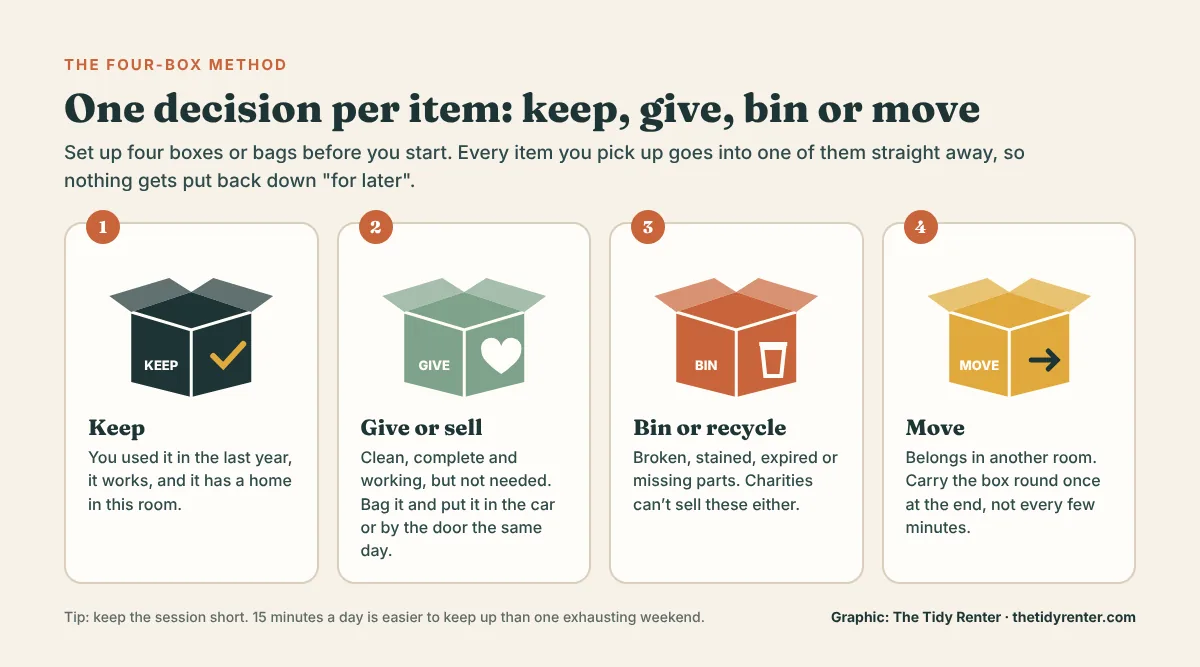
Keep sessions short. About 15 minutes a day is a common recommendation, and it works because you stop before you get tired and start keeping things just to finish. If you’re on a roll, keep going, but set a timer so you know when to stop.
The 7-day room-by-room plan
This order starts with the quick, easy rooms so you see results on day one, and leaves the hardest job, the closet, for the middle of the week. The times are a rough guide for a studio or one-bedroom apartment.
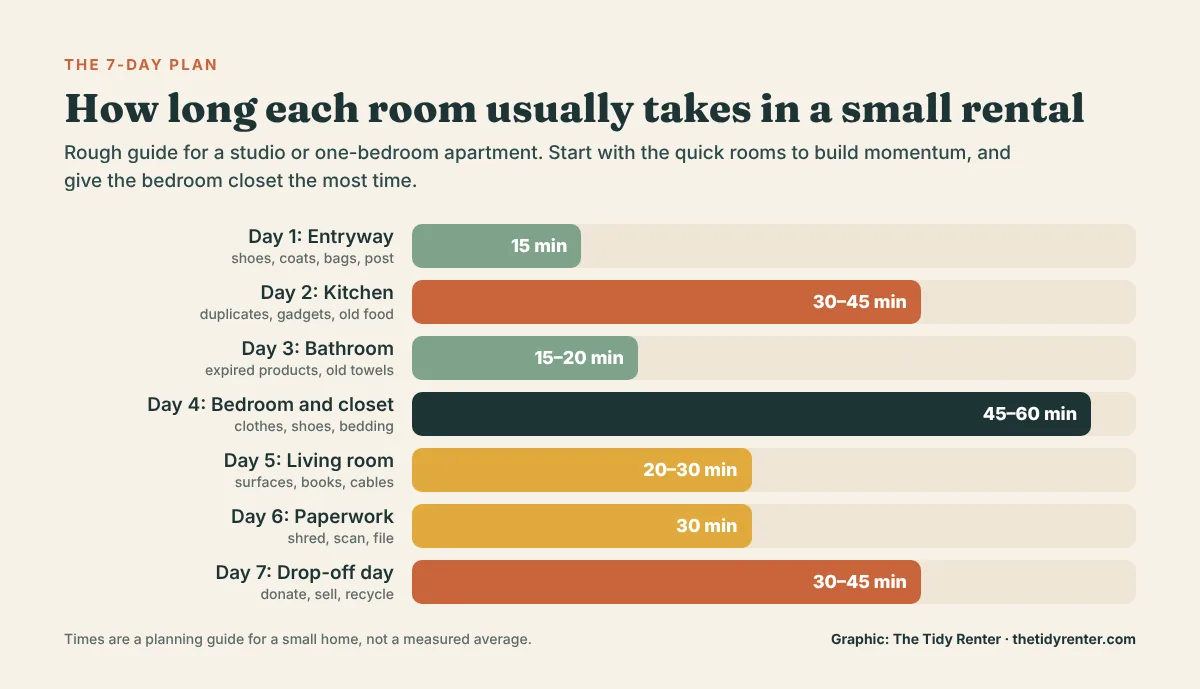
| Day | Room | Time | Main targets |
|---|---|---|---|
| 1 | Entryway | 15 min | Shoes, coats, bags, post |
| 2 | Kitchen | 30 to 45 min | Duplicates, gadgets, old food |
| 3 | Bathroom | 15 to 20 min | Expired products, medicines, towels |
| 4 | Bedroom and closet | 45 to 60 min | Clothes, shoes, bedding |
| 5 | Living room | 20 to 30 min | Surfaces, books, cables |
| 6 | Paperwork | 30 min | Shred, scan, file |
| 7 | Drop-off day | 30 to 45 min | Donate, sell, recycle |
Day 1: The entryway
| Renter Audit | |
|---|---|
| Cost | Free |
| Deposit risk | None |
| Payoff | High. It’s the first thing you see every day |
| Effort | 15 minutes |
The entryway is small, so it’s the perfect first win. Pull everything out of the shoe rack, coat hooks and the place where post lands.
- Shoes: keep the pairs you wear each week by the door. Move the rest to the closet, and give away anything you haven’t worn in a year.
- Coats and bags: one or two coats per person in season. Store the rest. Keep a few tote bags, not twenty.
- Post: recycle flyers straight away. Anything that needs action goes in one tray, not on the counter.
Day 2: The kitchen
| Renter Audit | |
|---|---|
| Cost | Free |
| Deposit risk | None |
| Payoff | High. Frees up the cupboards you use most |
| Effort | 30 to 45 minutes |
Kitchens collect duplicates. Work one cupboard or drawer at a time, and empty it fully before you decide what goes back.
- Duplicates: you rarely need more than one can opener, two spatulas or more mugs than you can fit in the cupboard.
- Gadgets: if you haven’t used it in a year, the bread maker or spiraliser can go to someone who will.
- Food: check dates on spices, sauces and tins. Old spices aren’t usually harmful, but they lose their flavour.
- Containers: match every container to a lid. Recycle the ones without a partner.
In a small rental kitchen, the aim is clear counters. Anything that lives on the counter should be something you use every day.
Day 3: The bathroom
| Renter Audit | |
|---|---|
| Cost | Free |
| Deposit risk | None |
| Payoff | Medium |
| Effort | 15 to 20 minutes |
- Expired products: sunscreen, make-up and old samples. Most have a small open-jar symbol showing how many months they last once opened.
- Medicines: don’t throw them in the bin or flush them unless the label says so. In the US, the FDA recommends a drug take-back site, a pharmacy kiosk or a mail-back envelope first. If none is available, mix them with something unappealing such as used coffee grounds or cat litter, seal them in a bag, and put them in the household trash (FDA). In England, community pharmacies accept unwanted medicines from households (Community Pharmacy England).
- Towels: two sets per person is plenty. Old towels are often welcome at local animal shelters, so call and ask.

The De Auditor’s Note
Christian, founder of The Tidy Renter
Medicines are the one thing I’d never put in a general declutter bag. Keep a separate small bag for them as you go through the bathroom, and take it to the pharmacy next time you’re passing. It takes no extra time and keeps old tablets out of the bin where kids or pets could find them.
Day 4: The bedroom and closet
| Renter Audit | |
|---|---|
| Cost | Free, and you may make money selling clothes |
| Deposit risk | None |
| Payoff | Very high. Clothing is the biggest source of clutter for most people |
| Effort | 45 to 60 minutes |
This is the big one, so give it your longest session. Take everything out of one section at a time: tops, then trousers, then shoes.
- The one-year rule: if you haven’t worn it in a year, through all four seasons, you probably won’t.
- Fit, not hope: keep clothes that fit you now. Clothes for “one day” take up the space you need today.
- The hanger trick: turn all your hangers backwards. When you wear something, hang it back the right way. After a few months, you’ll see exactly what you never wear.
- Bedding: two sets per bed is enough. One on the bed, one in the wash.
- Bin, don’t donate: single socks, worn underwear and stained clothes. Donation centres generally can’t sell them.
Day 5: The living room
| Renter Audit | |
|---|---|
| Cost | Free |
| Deposit risk | None |
| Payoff | High. Clear surfaces make a room look bigger |
| Effort | 20 to 30 minutes |
- Surfaces first: clear the coffee table, shelves and TV unit, then put back only what you use or love.
- Books, DVDs and games: keep the ones you’ll reread or replay. Many libraries and charity shops take the rest.
- Cables and chargers: match each one to a device you still own. The rest can be recycled with electricals.
- Decor: a few larger pieces look calmer than lots of small ones.
Day 6: Paperwork
| Renter Audit | |
|---|---|
| Cost | Free; a shredder is about $30 to $50 if you don’t have one |
| Deposit risk | None |
| Payoff | Medium. Less paper, and it’s easier to find what matters |
| Effort | 30 minutes |
- Keep: your lease or tenancy agreement, the move-in inventory or checklist, deposit protection paperwork, and anything showing rent paid. You’ll need these when you move out.
- Scan: warranties and receipts for things you own. A photo on your phone is often enough.
- Shred: old statements and letters with your name, address or account numbers, once you no longer need them.
- Recycle: manuals you can find online, flyers and old catalogues.
The De Auditor’s Tip
Make one folder, paper or digital, called “This rental”. Put the lease, move-in photos, inventory, deposit certificate and any emails with your landlord in it. When move-out day comes, everything you need to get your deposit back is in one place.
Day 7: Drop-off day
Sorting is only half the job. Bags of donations left in the hallway are still clutter. Make day 7 the day everything leaves.
Where to donate in the US
Goodwill, the Salvation Army and local thrift stores take most clean clothing, homeware and small furniture, but every location has its own list. For example, Goodwill of Greater Washington doesn’t accept mattresses, box springs, sleeper sofas, cribs, car seats, large appliances, paint or anything broken or stained (Goodwill of Greater Washington). Check your local store’s list before you load the car.
Where to donate in the UK
Charity shops take clothes, books and homeware. For furniture, the British Heart Foundation offers free collection of items in resaleable condition, and all upholstered furniture must have a valid fire safety label (Oliver Bonas and the British Heart Foundation). If the label has been cut off, the sofa can’t be resold.
Electronics and batteries
- US: wipe your personal data and take batteries out first. The EPA says lithium-ion batteries shouldn’t go in household trash or recycling bins, and many manufacturers and retailers offer recycling (EPA).
- UK: use the postcode search on the Recycle Your Electricals website to find drop-off points. Some retailers take items back: IKEA, for example, accepts small electricals up to 25 cm on the longest side without a purchase (Which?).
Selling
Selling is worth it for furniture, electronics and brand-name clothing. For everything else, the time it takes to photograph, list and meet buyers is often worth more than the few dollars or pounds you’ll get. Give yourself a deadline: if it hasn’t sold in two weeks, donate it.
How to keep it decluttered
- One in, one out: when something new comes in, something similar goes out.
- A donation bag in the closet: drop things in as you notice them. When it’s full, it goes.
- A 10-minute reset: once a week, put everything back where it lives.
- Repeat the plan every season, or before your lease renewal. It gets quicker every time.

The De Auditor’s Note
Christian, founder of The Tidy Renter
The best time to declutter a rental is about two months before you move out, not the week before. You’re moving less, the deadline is real, and you have time to sell the bigger pieces instead of paying someone to take them away. Anything you leave behind can also end up as a deduction from your deposit, so it pays to be early.
Renter-specific mistakes to avoid
- Throwing away things that belong to the landlord. Check your inventory before you bin the old shower curtain, blinds, spare keys or the appliance manuals. They may be listed.
- Leaving things in shared areas. Bags in the hallway, bike store or bin area can break your lease and annoy neighbours. Keep them inside until drop-off.
- Dumping bulky items. Leaving a mattress by the bins can lead to a fine or a charge from your landlord. Book a council or city bulky-item collection instead.
- Putting everything in a storage unit. If you wouldn’t pay to move it, you probably shouldn’t pay to store it.
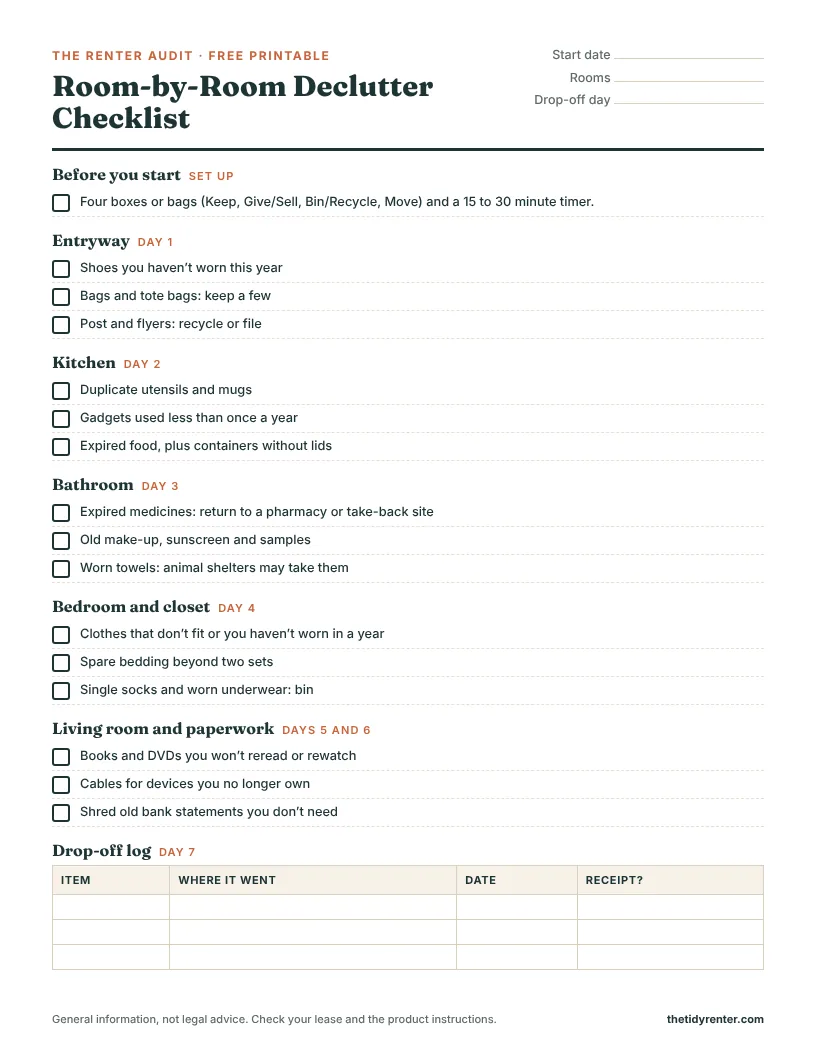
Free printable: Download the Room-by-Room Declutter Checklist (PDF). It has a checklist for each day of the plan and a drop-off log to track what went where.
Frequently asked questions
Where should I start decluttering when I’m overwhelmed?
Start with one small space you see every day, like the entryway or a single kitchen drawer, and set a timer for 15 minutes. A quick visible win makes it easier to keep going the next day.
How long does it take to declutter a whole home?
For a studio or one-bedroom apartment, about a week of short daily sessions is realistic. Bigger homes, or homes with a lot of stored items, can take a few weekends.
What is the four-box method?
You sort every item into one of four boxes: keep, give or sell, bin or recycle, and move to another room. It forces one decision per item so nothing gets put back down for later.
What should I get rid of first?
Easy things with no emotional pull: expired food and products, duplicates, broken items, single socks, old paperwork and cables for devices you no longer own.
What can’t I donate?
Most donation centres won’t take broken, stained or incomplete items, mattresses, child car seats or cribs, paint and chemicals, or large appliances. UK charities need a fire safety label on upholstered furniture. Always check your local list.
How do I declutter sentimental items?
Leave them until last, when deciding feels easier. Keep the best few, take photos of the rest, and use one box as a limit: when it’s full, something has to go before anything else comes in.
The bottom line: one room a day, four boxes, short sessions and a booked drop-off day. Do it once properly, then keep it under control with one in, one out.
Related guides on The Tidy Renter
- Small Apartment Storage Ideas for Renters: once you’ve decluttered, 11 no-drill ways to store what’s left.
- Studio Apartment Layout Ideas: measured floor plans and the spacing rules that make a small room work.
- Renter-Friendly Decor Ideas That Won’t Cost Your Deposit: make the space feel finished without touching the walls.
Update log
- October 2026: First published. Donation and disposal guidance checked.
Sources
- StorageCafe: clutter in America
- FOX 13: the four-box method
- FDA: where and how to dispose of unused medicines
- Community Pharmacy England: disposal of unwanted medicines
- Goodwill of Greater Washington: donations it cannot accept
- Oliver Bonas: British Heart Foundation furniture collection
- EPA: electronics donation and recycling
- Which?: how to recycle electrical items
Images: all graphics and the printable in this guide were designed by The Tidy Renter. No AI-generated images are used.
This guide is general information. Check your local donation and recycling rules before dropping items off.